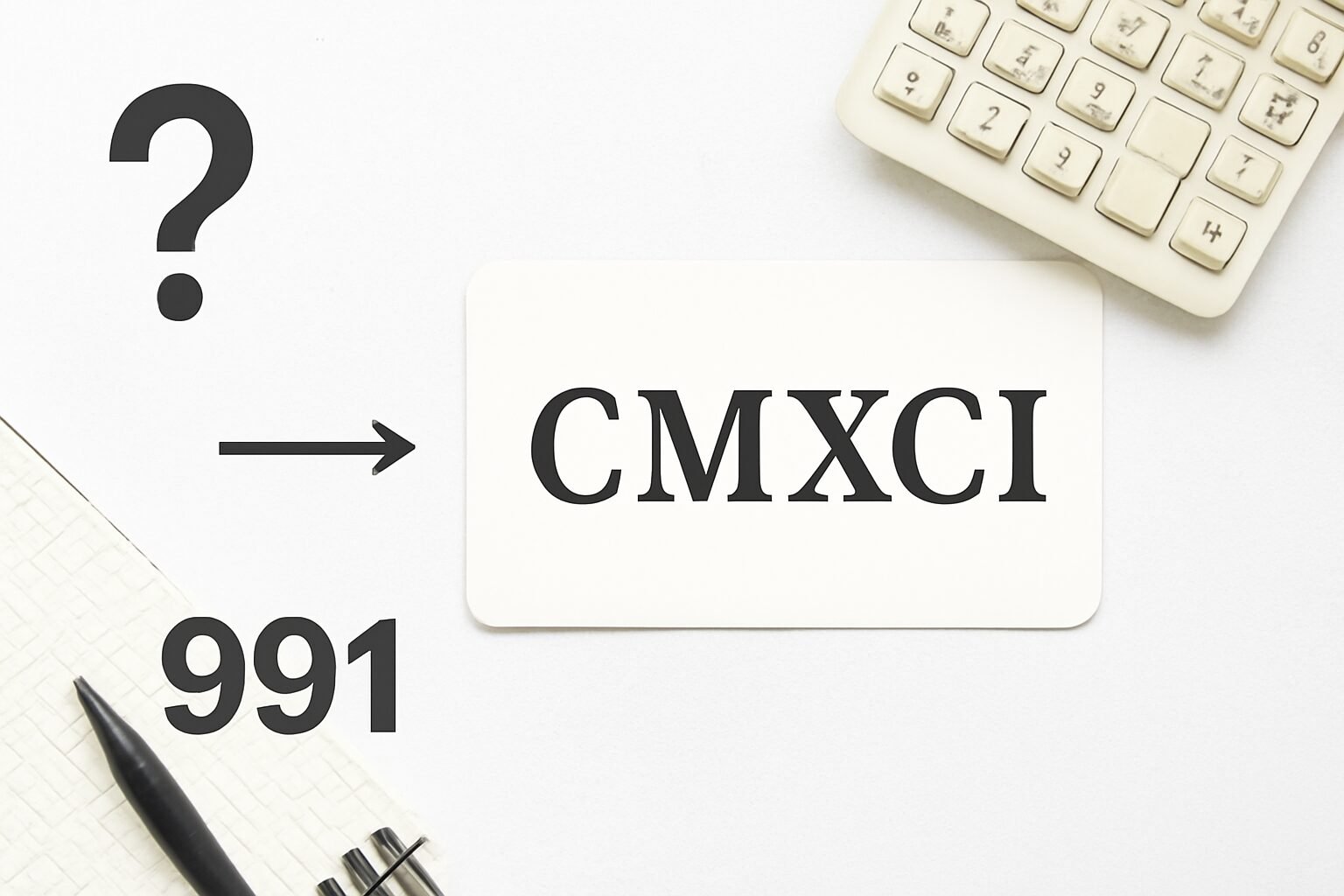
How to Convert 991 into Roman Numerals
Roman numerals are made up of seven letters: I (1), V (5), X (10), L (50), C (100), D (500), and M (1000). To write a number like 991, we combine these letters starting from the largest value and working down to the smallest.
Let's break 991 into parts and build the Roman numeral step by step:
900 fits into what's left of the number one time.
That means we add CM to our Roman numeral because one × nine hundred equals 900.
90 fits into what's left of the number one time.
That means we add XC to our Roman numeral because one × ninety equals 90.
1 fits into what's left of the number one time.
That means we add I to our Roman numeral because one × one equals 1.
Final Answer
After combining all the parts, the Roman numeral for 991 is:
CMXCI
Tip: If a smaller numeral appears before a larger one (like IV), it means you subtract. If a smaller one comes after a larger one (like VI), it means you add. You'll see both styles when needed.
How to Convert the Roman Numeral CMXCI into a Normal Number
To convert a Roman numeral to a normal number, we read it from left to right and add up the values of each symbol. However, if a smaller symbol appears before a larger one, we subtract the smaller value instead of adding it.
Let's break down CMXCI step by step:
Step 1: We see CM, which means we subtract nine hundred (subtract 900).
This is a subtraction case because C is smaller than M.
Step 2: We see XC, which means we subtract ninety (subtract 90).
This is a subtraction case because X is smaller than C.
Step 3: We see I, which means we add one (add 1).
Total calculation: CM (900) + XC (90) + I (1) = 991
Final Answer
The normal number for the Roman numeral CMXCI is:
991
Tip: Remember the key rule. If a smaller numeral appears before a larger one (like IV), subtract the smaller value. If a smaller one comes after a larger one (like VI), add the values together.
What happened in the year 991?
In the year 991, the Battle of Maldon occurred, where Anglo-Saxon forces led by Byrhtnoth fought against Viking invaders.
In the year 991, Æthelred the Unready agreed to pay Danegeld to the Vikings to prevent further attacks on England.
In the year 991, the city of London was attacked by a Viking fleet, contributing to the pressure on King Æthelred.
In the year 991, the first recorded mention of the city of Gdańsk (Danzig) in historical documents occurred.
In the year 991, the Synod of Mâcon was held, addressing ecclesiastical matters in the Frankish kingdom.