How to Convert 1690 into Roman Numerals
Roman numerals are made up of seven letters: I (1), V (5), X (10), L (50), C (100), D (500), and M (1000). To write a number like 1690, we combine these letters starting from the largest value and working down to the smallest.
Let's break 1690 into parts and build the Roman numeral step by step:
1000 fits into what's left of the number one time.
That means we add M to our Roman numeral because one × one thousand equals 1000.
500 fits into what's left of the number one time.
That means we add D to our Roman numeral because one × five hundred equals 500.
100 fits into what's left of the number one time.
That means we add C to our Roman numeral because one × one hundred equals 100.
90 fits into what's left of the number one time.
That means we add XC to our Roman numeral because one × ninety equals 90.
Final Answer
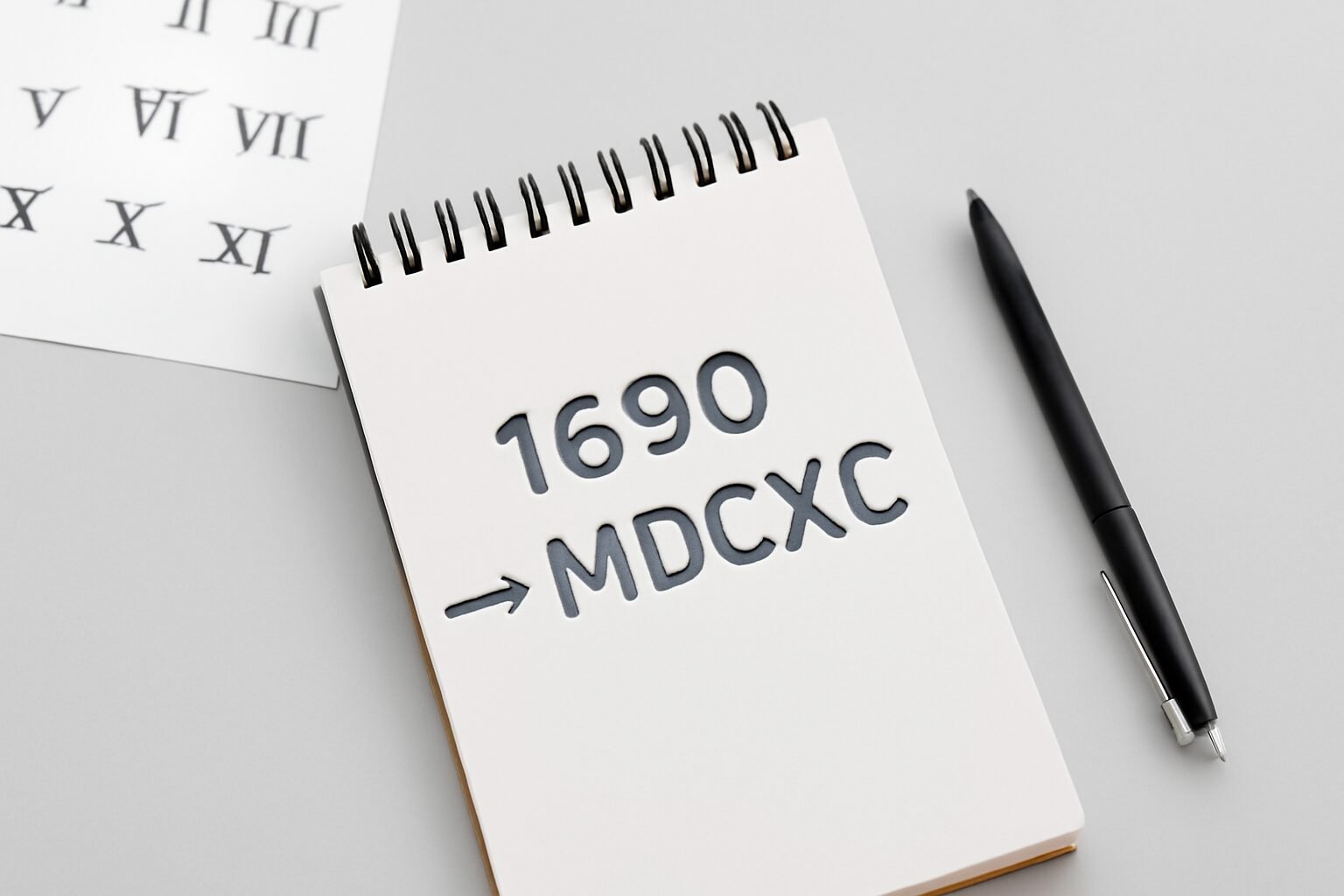
After combining all the parts, the Roman numeral for 1690 is:
MDCXC
Tip: If a smaller numeral appears before a larger one (like IV), it means you subtract. If a smaller one comes after a larger one (like VI), it means you add. You'll see both styles when needed.
How to Convert the Roman Numeral MDCXC into a Normal Number
To convert a Roman numeral to a normal number, we read it from left to right and add up the values of each symbol. However, if a smaller symbol appears before a larger one, we subtract the smaller value instead of adding it.
Let's break down MDCXC step by step:
Step 1: We see M, which means we add one thousand (add 1000).
Step 2: We see D, which means we add five hundred (add 500).
Step 3: We see C, which means we add one hundred (add 100).
Step 4: We see XC, which means we subtract ninety (subtract 90).
This is a subtraction case because X is smaller than C.
Total calculation: M (1000) + D (500) + C (100) + XC (90) = 1690
Final Answer
The normal number for the Roman numeral MDCXC is:
1690
Tip: Remember the key rule. If a smaller numeral appears before a larger one (like IV), subtract the smaller value. If a smaller one comes after a larger one (like VI), add the values together.