How to Convert 1737 into Roman Numerals
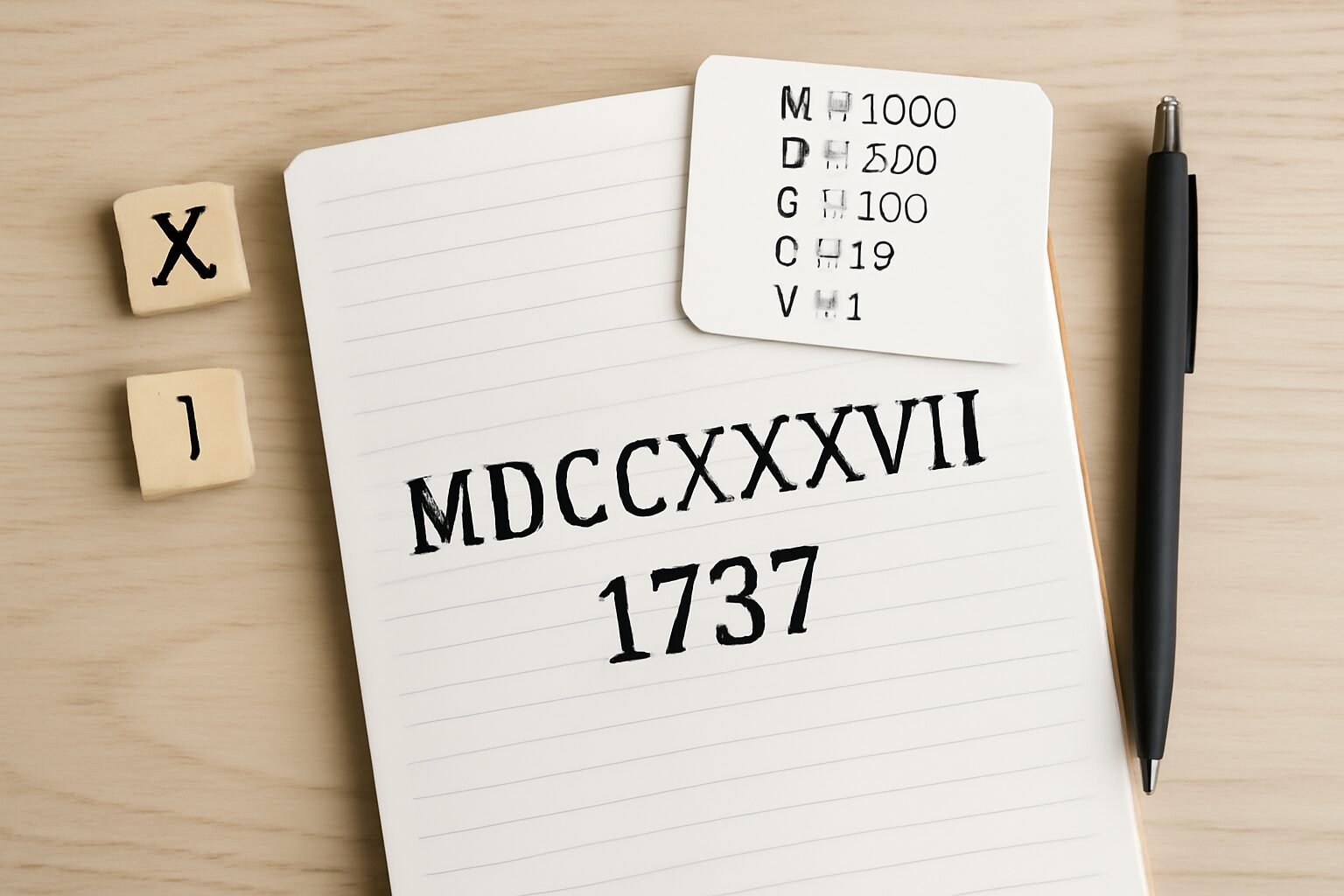
Roman numerals are made up of seven letters: I (1), V (5), X (10), L (50), C (100), D (500), and M (1000). To write a number like 1737, we combine these letters starting from the largest value and working down to the smallest.
Let's break 1737 into parts and build the Roman numeral step by step:
1000 fits into what's left of the number one time.
That means we add M to our Roman numeral because one × one thousand equals 1000.
500 fits into what's left of the number one time.
That means we add D to our Roman numeral because one × five hundred equals 500.
100 fits into what's left of the number two times.
That means we add CC to our Roman numeral because two × one hundred equals 200.
10 fits into what's left of the number three times.
That means we add XXX to our Roman numeral because three × ten equals 30.
5 fits into what's left of the number one time.
That means we add V to our Roman numeral because one × five equals 5.
1 fits into what's left of the number two times.
That means we add II to our Roman numeral because two × one equals 2.
Final Answer
After combining all the parts, the Roman numeral for 1737 is:
MDCCXXXVII
Tip: If a smaller numeral appears before a larger one (like IV), it means you subtract. If a smaller one comes after a larger one (like VI), it means you add. You'll see both styles when needed.
How to Convert the Roman Numeral MDCCXXXVII into a Normal Number
To convert a Roman numeral to a normal number, we read it from left to right and add up the values of each symbol. However, if a smaller symbol appears before a larger one, we subtract the smaller value instead of adding it.
Let's break down MDCCXXXVII step by step:
Step 1: We see M, which means we add one thousand (add 1000).
Step 2: We see D, which means we add five hundred (add 500).
Step 3: We see C, which means we add one hundred (add 100).
Step 4: We see C, which means we add one hundred (add 100).
Step 5: We see X, which means we add ten (add 10).
Step 6: We see X, which means we add ten (add 10).
Step 7: We see X, which means we add ten (add 10).
Step 8: We see V, which means we add five (add 5).
Step 9: We see I, which means we add one (add 1).
Step 10: We see I, which means we add one (add 1).
Total calculation: M (1000) + D (500) + C (100) + C (100) + X (10) + X (10) + X (10) + V (5) + I (1) + I (1) = 1737
Final Answer
The normal number for the Roman numeral MDCCXXXVII is:
1737
Tip: Remember the key rule. If a smaller numeral appears before a larger one (like IV), subtract the smaller value. If a smaller one comes after a larger one (like VI), add the values together.
Number Analysis of 1737
What happened in the year 1737?
In the year 1737, the city of Calcutta was struck by a devastating cyclone, resulting in significant loss of life and destruction.
In the year 1737, the first successful separation of Siamese twins was performed by a surgeon in Denmark.
In the year 1737, the Italian composer Antonio Vivaldi premiered his opera "Catone in Utica" in Verona.
In the year 1737, the future Empress Maria Theresa of Austria married Francis Stephen of Lorraine, strengthening Habsburg alliances.
In the year 1737, the first recorded performance of Handel's "Funeral Anthem for Queen Caroline" took place in London.