How to Convert 1758 into Roman Numerals
Roman numerals are made up of seven letters: I (1), V (5), X (10), L (50), C (100), D (500), and M (1000). To write a number like 1758, we combine these letters starting from the largest value and working down to the smallest.
Let's break 1758 into parts and build the Roman numeral step by step:
1000 fits into what's left of the number one time.
That means we add M to our Roman numeral because one × one thousand equals 1000.
500 fits into what's left of the number one time.
That means we add D to our Roman numeral because one × five hundred equals 500.
100 fits into what's left of the number two times.
That means we add CC to our Roman numeral because two × one hundred equals 200.
50 fits into what's left of the number one time.
That means we add L to our Roman numeral because one × fifty equals 50.
5 fits into what's left of the number one time.
That means we add V to our Roman numeral because one × five equals 5.
1 fits into what's left of the number three times.
That means we add III to our Roman numeral because three × one equals 3.
Final Answer
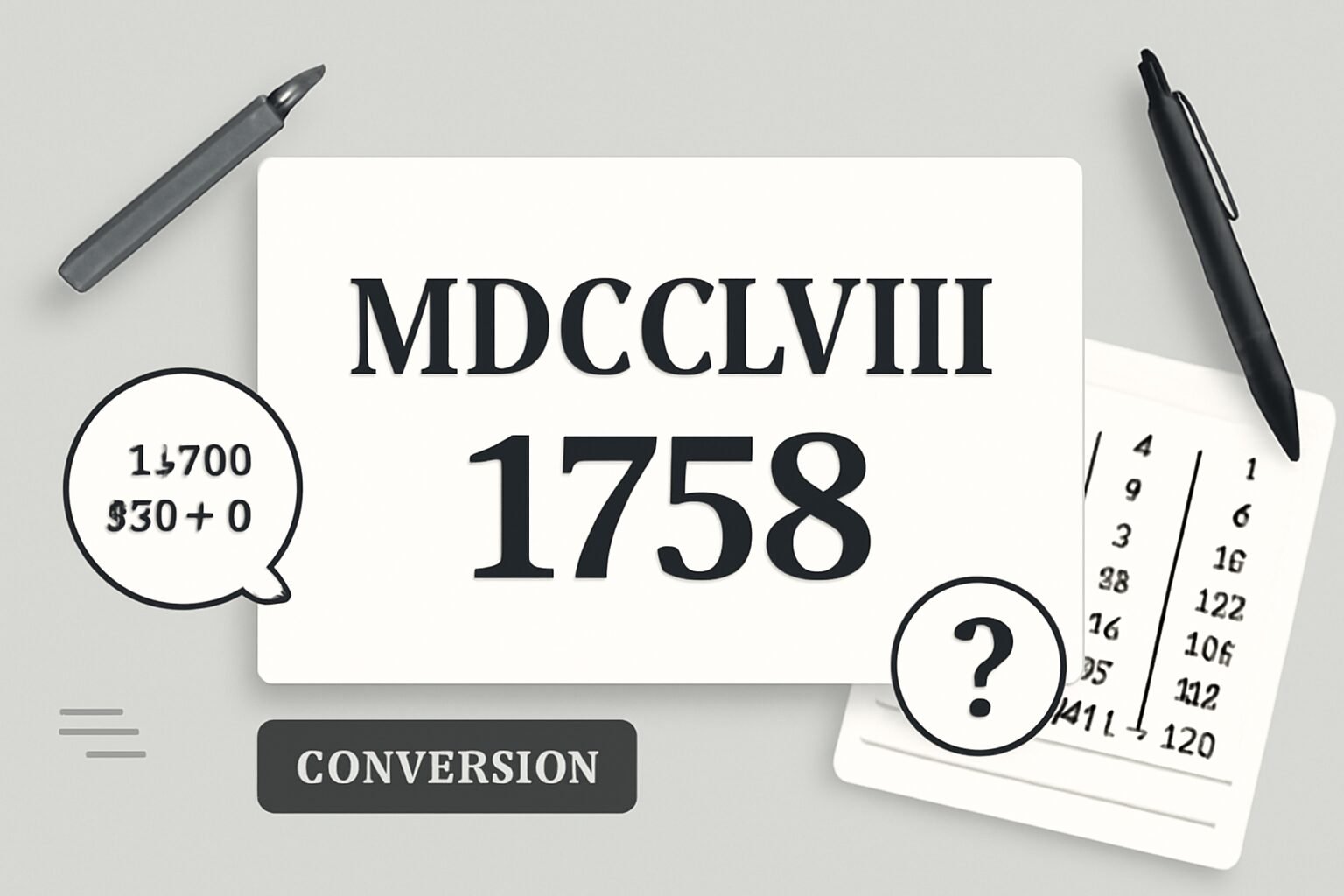
After combining all the parts, the Roman numeral for 1758 is:
MDCCLVIII
Tip: If a smaller numeral appears before a larger one (like IV), it means you subtract. If a smaller one comes after a larger one (like VI), it means you add. You'll see both styles when needed.
How to Convert the Roman Numeral MDCCLVIII into a Normal Number
To convert a Roman numeral to a normal number, we read it from left to right and add up the values of each symbol. However, if a smaller symbol appears before a larger one, we subtract the smaller value instead of adding it.
Let's break down MDCCLVIII step by step:
Step 1: We see M, which means we add one thousand (add 1000).
Step 2: We see D, which means we add five hundred (add 500).
Step 3: We see C, which means we add one hundred (add 100).
Step 4: We see C, which means we add one hundred (add 100).
Step 5: We see L, which means we add fifty (add 50).
Step 6: We see V, which means we add five (add 5).
Step 7: We see I, which means we add one (add 1).
Step 8: We see I, which means we add one (add 1).
Step 9: We see I, which means we add one (add 1).
Total calculation: M (1000) + D (500) + C (100) + C (100) + L (50) + V (5) + I (1) + I (1) + I (1) = 1758
Final Answer
The normal number for the Roman numeral MDCCLVIII is:
1758
Tip: Remember the key rule. If a smaller numeral appears before a larger one (like IV), subtract the smaller value. If a smaller one comes after a larger one (like VI), add the values together.
Number Analysis of 1758
What happened in the year 1758?
In the year 1758, the British captured the French fortress of Louisbourg in North America during the Seven Years' War.
In the year 1758, the first recorded use of the word "electrician" appeared in print.
In the year 1758, the French and Indian War saw the Battle of Carillon, where the French successfully defended Fort Ticonderoga.
In the year 1758, the first American synagogue, the Touro Synagogue in Newport, Rhode Island, was dedicated.
In the year 1758, the British Royal Navy captured the French island of Gorée off the coast of Senegal.
In the year 1758, the German composer Carl Philipp Emanuel Bach published his influential "Essay on the True Art of Playing Keyboard Instruments."
In the year 1758, the Swedish naturalist Carl Linnaeus published the 10th edition of "Systema Naturae," which introduced binomial nomenclature for species.
In the year 1758, the French philosopher and writer Voltaire purchased an estate at Ferney, where he would live and work for the next 20 years.
In the year 1758, the British East India Company captured the French settlement of Chandannagar in India.
In the year 1758, the first known use of the term "biology" in its modern sense was recorded.