How to Convert 1863 into Roman Numerals
Roman numerals are made up of seven letters: I (1), V (5), X (10), L (50), C (100), D (500), and M (1000). To write a number like 1863, we combine these letters starting from the largest value and working down to the smallest.
Let's break 1863 into parts and build the Roman numeral step by step:
1000 fits into what's left of the number one time.
That means we add M to our Roman numeral because one × one thousand equals 1000.
500 fits into what's left of the number one time.
That means we add D to our Roman numeral because one × five hundred equals 500.
100 fits into what's left of the number three times.
That means we add CCC to our Roman numeral because three × one hundred equals 300.
50 fits into what's left of the number one time.
That means we add L to our Roman numeral because one × fifty equals 50.
10 fits into what's left of the number one time.
That means we add X to our Roman numeral because one × ten equals 10.
1 fits into what's left of the number three times.
That means we add III to our Roman numeral because three × one equals 3.
Final Answer
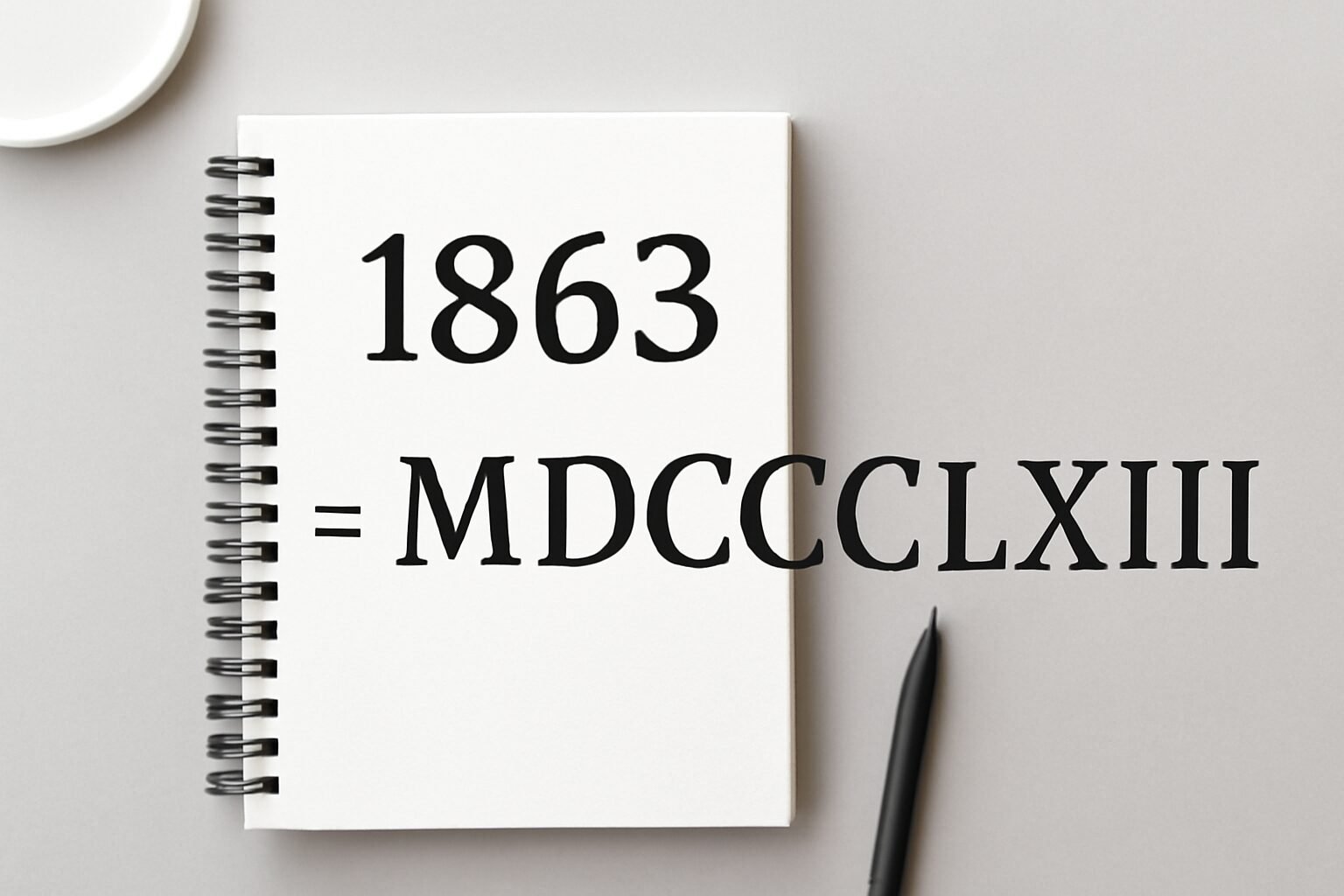
After combining all the parts, the Roman numeral for 1863 is:
MDCCCLXIII
Tip: If a smaller numeral appears before a larger one (like IV), it means you subtract. If a smaller one comes after a larger one (like VI), it means you add. You'll see both styles when needed.
How to Convert the Roman Numeral MDCCCLXIII into a Normal Number
To convert a Roman numeral to a normal number, we read it from left to right and add up the values of each symbol. However, if a smaller symbol appears before a larger one, we subtract the smaller value instead of adding it.
Let's break down MDCCCLXIII step by step:
Step 1: We see M, which means we add one thousand (add 1000).
Step 2: We see D, which means we add five hundred (add 500).
Step 3: We see C, which means we add one hundred (add 100).
Step 4: We see C, which means we add one hundred (add 100).
Step 5: We see C, which means we add one hundred (add 100).
Step 6: We see L, which means we add fifty (add 50).
Step 7: We see X, which means we add ten (add 10).
Step 8: We see I, which means we add one (add 1).
Step 9: We see I, which means we add one (add 1).
Step 10: We see I, which means we add one (add 1).
Total calculation: M (1000) + D (500) + C (100) + C (100) + C (100) + L (50) + X (10) + I (1) + I (1) + I (1) = 1863
Final Answer
The normal number for the Roman numeral MDCCCLXIII is:
1863
Tip: Remember the key rule. If a smaller numeral appears before a larger one (like IV), subtract the smaller value. If a smaller one comes after a larger one (like VI), add the values together.
Number Analysis of 1863
What happened in the year 1863?
In the year 1863, the Emancipation Proclamation took effect, declaring freedom for enslaved people in Confederate states.
In the year 1863, the Battle of Gettysburg was fought, a major turning point in the American Civil War.
In the year 1863, President Abraham Lincoln delivered the Gettysburg Address, honoring fallen soldiers and reaffirming the principles of liberty and equality.
In the year 1863, the first underground railway opened in London, known as the Metropolitan Railway.
In the year 1863, the International Red Cross was founded in Geneva, Switzerland, to provide humanitarian aid during conflicts.
In the year 1863, the first-ever college football game was played between Princeton and Rutgers.
In the year 1863, French painter Édouard Manet exhibited his controversial painting "Olympia" in Paris.
In the year 1863, the New York City draft riots broke out, one of the largest civil insurrections in U.S. history.
In the year 1863, the Kingdom of Italy was formally proclaimed, with Victor Emmanuel II as its first king.
In the year 1863, the first section of the London Underground's Metropolitan Line began operation.