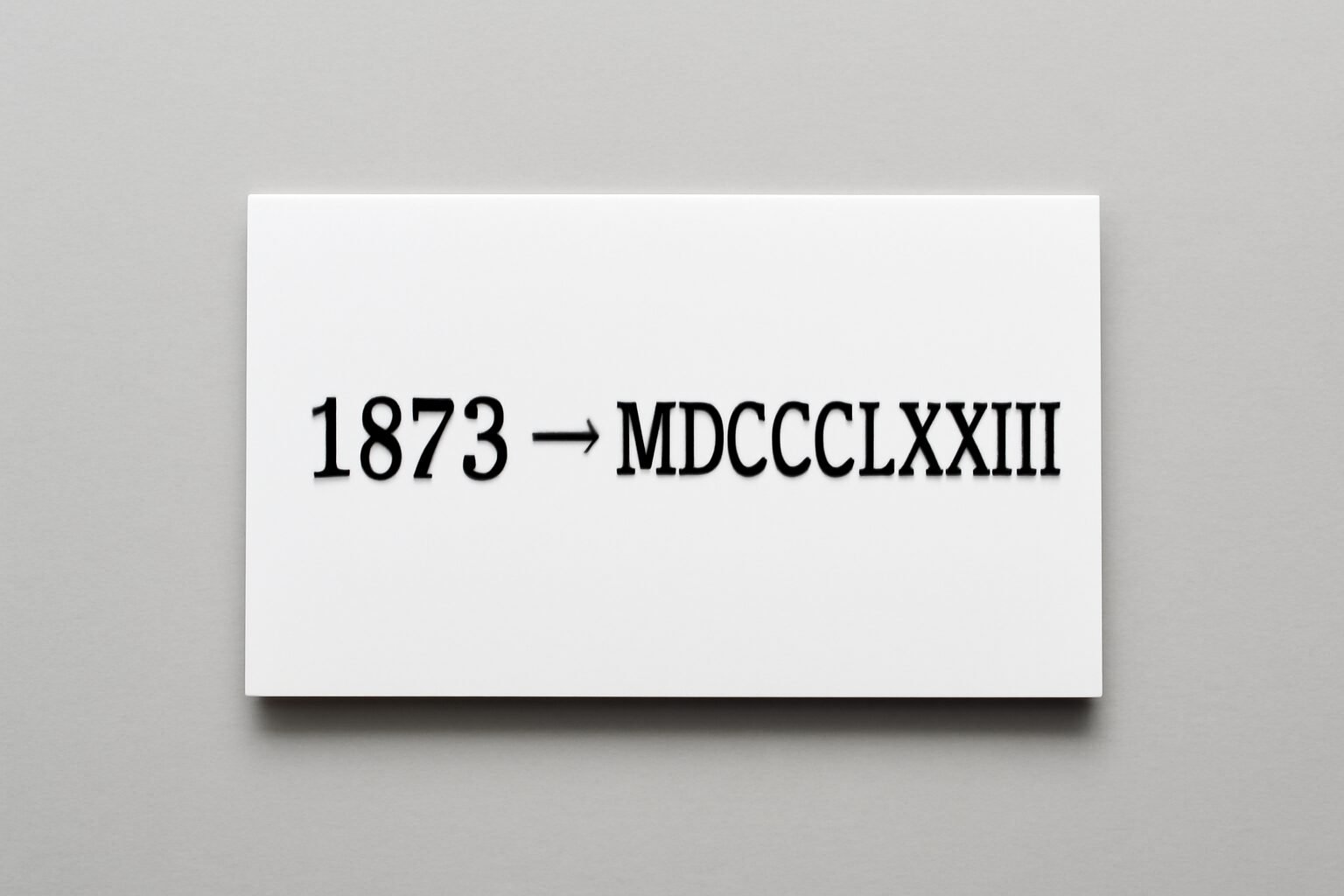
How to Convert 1873 into Roman Numerals
Roman numerals are made up of seven letters: I (1), V (5), X (10), L (50), C (100), D (500), and M (1000). To write a number like 1873, we combine these letters starting from the largest value and working down to the smallest.
Let's break 1873 into parts and build the Roman numeral step by step:
1000 fits into what's left of the number one time.
That means we add M to our Roman numeral because one × one thousand equals 1000.
500 fits into what's left of the number one time.
That means we add D to our Roman numeral because one × five hundred equals 500.
100 fits into what's left of the number three times.
That means we add CCC to our Roman numeral because three × one hundred equals 300.
50 fits into what's left of the number one time.
That means we add L to our Roman numeral because one × fifty equals 50.
10 fits into what's left of the number two times.
That means we add XX to our Roman numeral because two × ten equals 20.
1 fits into what's left of the number three times.
That means we add III to our Roman numeral because three × one equals 3.
Final Answer
After combining all the parts, the Roman numeral for 1873 is:
MDCCCLXXIII
Tip: If a smaller numeral appears before a larger one (like IV), it means you subtract. If a smaller one comes after a larger one (like VI), it means you add. You'll see both styles when needed.
How to Convert the Roman Numeral MDCCCLXXIII into a Normal Number
To convert a Roman numeral to a normal number, we read it from left to right and add up the values of each symbol. However, if a smaller symbol appears before a larger one, we subtract the smaller value instead of adding it.
Let's break down MDCCCLXXIII step by step:
Step 1: We see M, which means we add one thousand (add 1000).
Step 2: We see D, which means we add five hundred (add 500).
Step 3: We see C, which means we add one hundred (add 100).
Step 4: We see C, which means we add one hundred (add 100).
Step 5: We see C, which means we add one hundred (add 100).
Step 6: We see L, which means we add fifty (add 50).
Step 7: We see X, which means we add ten (add 10).
Step 8: We see X, which means we add ten (add 10).
Step 9: We see I, which means we add one (add 1).
Step 10: We see I, which means we add one (add 1).
Step 11: We see I, which means we add one (add 1).
Total calculation: M (1000) + D (500) + C (100) + C (100) + C (100) + L (50) + X (10) + X (10) + I (1) + I (1) + I (1) = 1873
Final Answer
The normal number for the Roman numeral MDCCCLXXIII is:
1873
Tip: Remember the key rule. If a smaller numeral appears before a larger one (like IV), subtract the smaller value. If a smaller one comes after a larger one (like VI), add the values together.
What happened in the year 1873?
In the year 1873, the first cable car began operation in San Francisco, providing a new mode of urban transport.
In the year 1873, the financial panic of 1873 began in the United States, leading to a severe economic depression.
In the year 1873, Levi Strauss and Jacob Davis received a patent for blue jeans with copper rivets, creating durable work pants.
In the year 1873, Jules Verne published "Around the World in Eighty Days," captivating readers with an adventurous global journey.
In the year 1873, the Vienna World's Fair opened, showcasing innovations and cultures from around the globe.