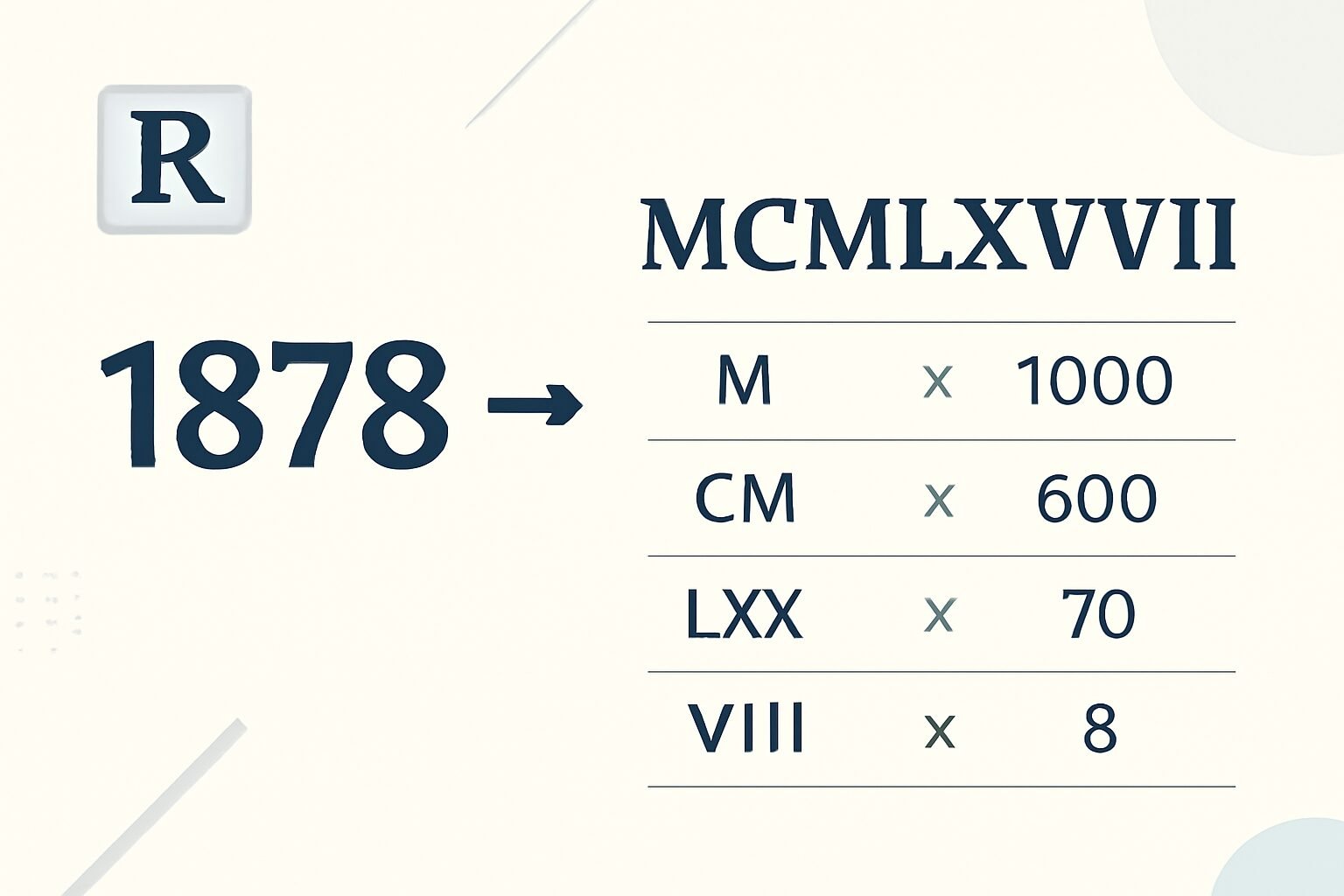
How to Convert 1878 into Roman Numerals
Roman numerals are made up of seven letters: I (1), V (5), X (10), L (50), C (100), D (500), and M (1000). To write a number like 1878, we combine these letters starting from the largest value and working down to the smallest.
Let's break 1878 into parts and build the Roman numeral step by step:
1000 fits into what's left of the number one time.
That means we add M to our Roman numeral because one × one thousand equals 1000.
500 fits into what's left of the number one time.
That means we add D to our Roman numeral because one × five hundred equals 500.
100 fits into what's left of the number three times.
That means we add CCC to our Roman numeral because three × one hundred equals 300.
50 fits into what's left of the number one time.
That means we add L to our Roman numeral because one × fifty equals 50.
10 fits into what's left of the number two times.
That means we add XX to our Roman numeral because two × ten equals 20.
5 fits into what's left of the number one time.
That means we add V to our Roman numeral because one × five equals 5.
1 fits into what's left of the number three times.
That means we add III to our Roman numeral because three × one equals 3.
Final Answer
After combining all the parts, the Roman numeral for 1878 is:
MDCCCLXXVIII
Tip: If a smaller numeral appears before a larger one (like IV), it means you subtract. If a smaller one comes after a larger one (like VI), it means you add. You'll see both styles when needed.
How to Convert the Roman Numeral MDCCCLXXVIII into a Normal Number
To convert a Roman numeral to a normal number, we read it from left to right and add up the values of each symbol. However, if a smaller symbol appears before a larger one, we subtract the smaller value instead of adding it.
Let's break down MDCCCLXXVIII step by step:
Step 1: We see M, which means we add one thousand (add 1000).
Step 2: We see D, which means we add five hundred (add 500).
Step 3: We see C, which means we add one hundred (add 100).
Step 4: We see C, which means we add one hundred (add 100).
Step 5: We see C, which means we add one hundred (add 100).
Step 6: We see L, which means we add fifty (add 50).
Step 7: We see X, which means we add ten (add 10).
Step 8: We see X, which means we add ten (add 10).
Step 9: We see V, which means we add five (add 5).
Step 10: We see I, which means we add one (add 1).
Step 11: We see I, which means we add one (add 1).
Step 12: We see I, which means we add one (add 1).
Total calculation: M (1000) + D (500) + C (100) + C (100) + C (100) + L (50) + X (10) + X (10) + V (5) + I (1) + I (1) + I (1) = 1878
Final Answer
The normal number for the Roman numeral MDCCCLXXVIII is:
1878
Tip: Remember the key rule. If a smaller numeral appears before a larger one (like IV), subtract the smaller value. If a smaller one comes after a larger one (like VI), add the values together.
Number Analysis of 1878
What happened in the year 1878?
In the year 1878, the first commercial telephone exchange opened in New Haven, Connecticut.
In the year 1878, Thomas Edison patented the phonograph, revolutionizing sound recording.
In the year 1878, the Congress of Berlin redrew the map of the Balkans after the Russo-Turkish War.
In the year 1878, the first electric street lighting was installed in London using arc lamps.
In the year 1878, the first-ever women's suffrage amendment was introduced in the U.S. Congress.
In the year 1878, the first-ever bicycle race took place at the Parc de Saint-Cloud in Paris.
In the year 1878, the first telephone directory was issued in New Haven, containing just 50 names.
In the year 1878, the first-ever college football game using modern rules was played between Harvard and McGill.
In the year 1878, the first-ever recorded case of a solar flare was observed by Richard Carrington.
In the year 1878, the first-ever purpose-built concert hall, the Royal Albert Hall, opened in London.