How to Convert 1887 into Roman Numerals
Roman numerals are made up of seven letters: I (1), V (5), X (10), L (50), C (100), D (500), and M (1000). To write a number like 1887, we combine these letters starting from the largest value and working down to the smallest.
Let's break 1887 into parts and build the Roman numeral step by step:
1000 fits into what's left of the number one time.
That means we add M to our Roman numeral because one × one thousand equals 1000.
500 fits into what's left of the number one time.
That means we add D to our Roman numeral because one × five hundred equals 500.
100 fits into what's left of the number three times.
That means we add CCC to our Roman numeral because three × one hundred equals 300.
50 fits into what's left of the number one time.
That means we add L to our Roman numeral because one × fifty equals 50.
10 fits into what's left of the number three times.
That means we add XXX to our Roman numeral because three × ten equals 30.
5 fits into what's left of the number one time.
That means we add V to our Roman numeral because one × five equals 5.
1 fits into what's left of the number two times.
That means we add II to our Roman numeral because two × one equals 2.
Final Answer
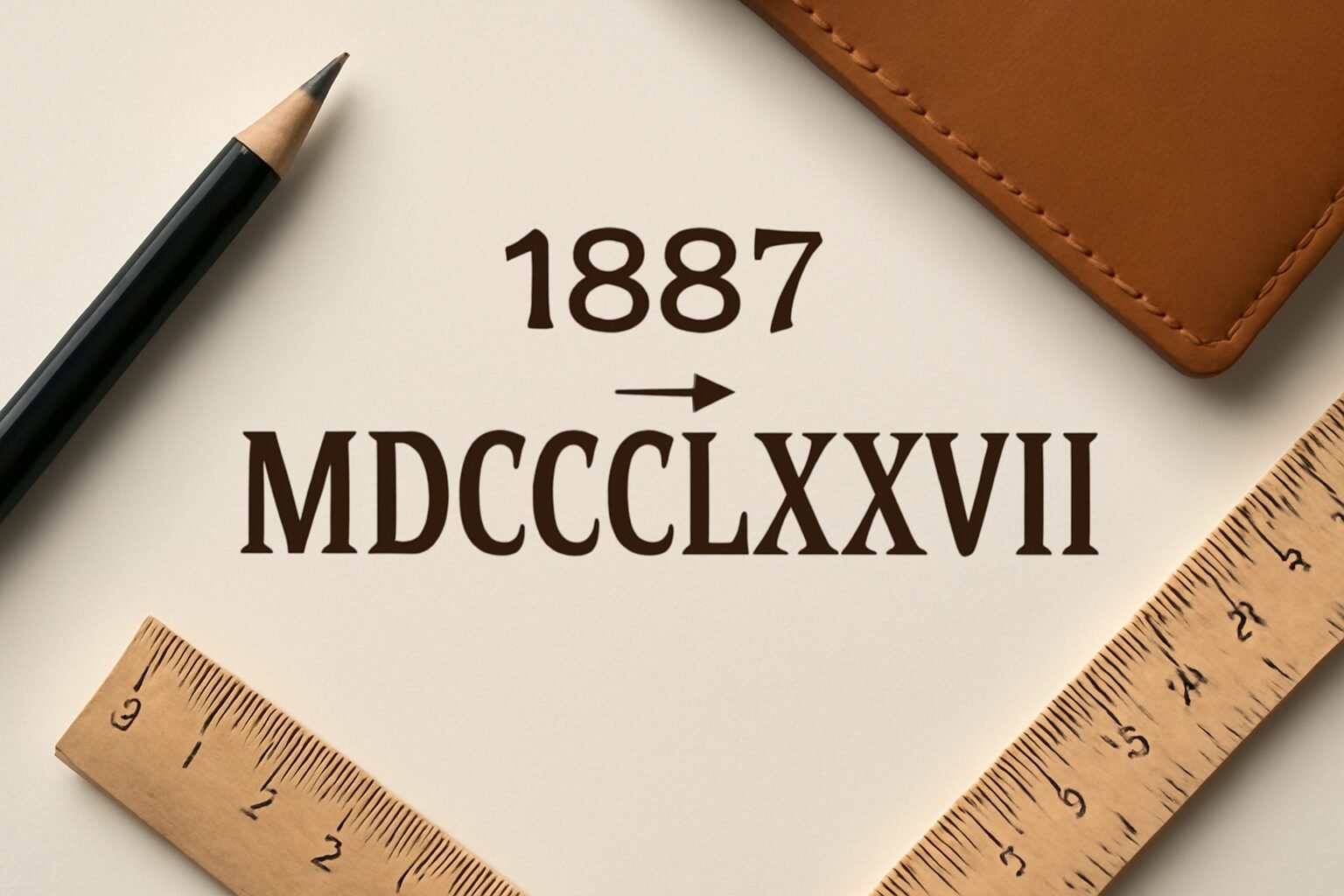
After combining all the parts, the Roman numeral for 1887 is:
MDCCCLXXXVII
Tip: If a smaller numeral appears before a larger one (like IV), it means you subtract. If a smaller one comes after a larger one (like VI), it means you add. You'll see both styles when needed.
How to Convert the Roman Numeral MDCCCLXXXVII into a Normal Number
To convert a Roman numeral to a normal number, we read it from left to right and add up the values of each symbol. However, if a smaller symbol appears before a larger one, we subtract the smaller value instead of adding it.
Let's break down MDCCCLXXXVII step by step:
Step 1: We see M, which means we add one thousand (add 1000).
Step 2: We see D, which means we add five hundred (add 500).
Step 3: We see C, which means we add one hundred (add 100).
Step 4: We see C, which means we add one hundred (add 100).
Step 5: We see C, which means we add one hundred (add 100).
Step 6: We see L, which means we add fifty (add 50).
Step 7: We see X, which means we add ten (add 10).
Step 8: We see X, which means we add ten (add 10).
Step 9: We see X, which means we add ten (add 10).
Step 10: We see V, which means we add five (add 5).
Step 11: We see I, which means we add one (add 1).
Step 12: We see I, which means we add one (add 1).
Total calculation: M (1000) + D (500) + C (100) + C (100) + C (100) + L (50) + X (10) + X (10) + X (10) + V (5) + I (1) + I (1) = 1887
Final Answer
The normal number for the Roman numeral MDCCCLXXXVII is:
1887
Tip: Remember the key rule. If a smaller numeral appears before a larger one (like IV), subtract the smaller value. If a smaller one comes after a larger one (like VI), add the values together.
Number Analysis of 1887
What happened in the year 1887?
In the year 1887, Queen Victoria celebrated her Golden Jubilee, marking 50 years on the British throne.
In the year 1887, Arthur Conan Doyle published his first Sherlock Holmes story, "A Study in Scarlet."
In the year 1887, the Michelson-Morley experiment was conducted, which later influenced Einstein's theory of relativity.
In the year 1887, Heinrich Hertz discovered the photoelectric effect, a key principle in quantum mechanics.
In the year 1887, the French Riviera town of Cannes held its first film festival, though it was not yet the famous event it is today.
In the year 1887, the United States Congress passed the Dawes Act, aiming to assimilate Native Americans by redistributing tribal lands.
In the year 1887, the first successful adding machine with a printer, invented by William Seward Burroughs, was patented.
In the year 1887, Bram Stoker began writing his iconic Gothic novel, "Dracula."
In the year 1887, the construction of the Eiffel Tower started in Paris, France, as the entrance arch for the 1889 World's Fair.
In the year 1887, the first issue of "National Geographic Magazine" was published in the United States.