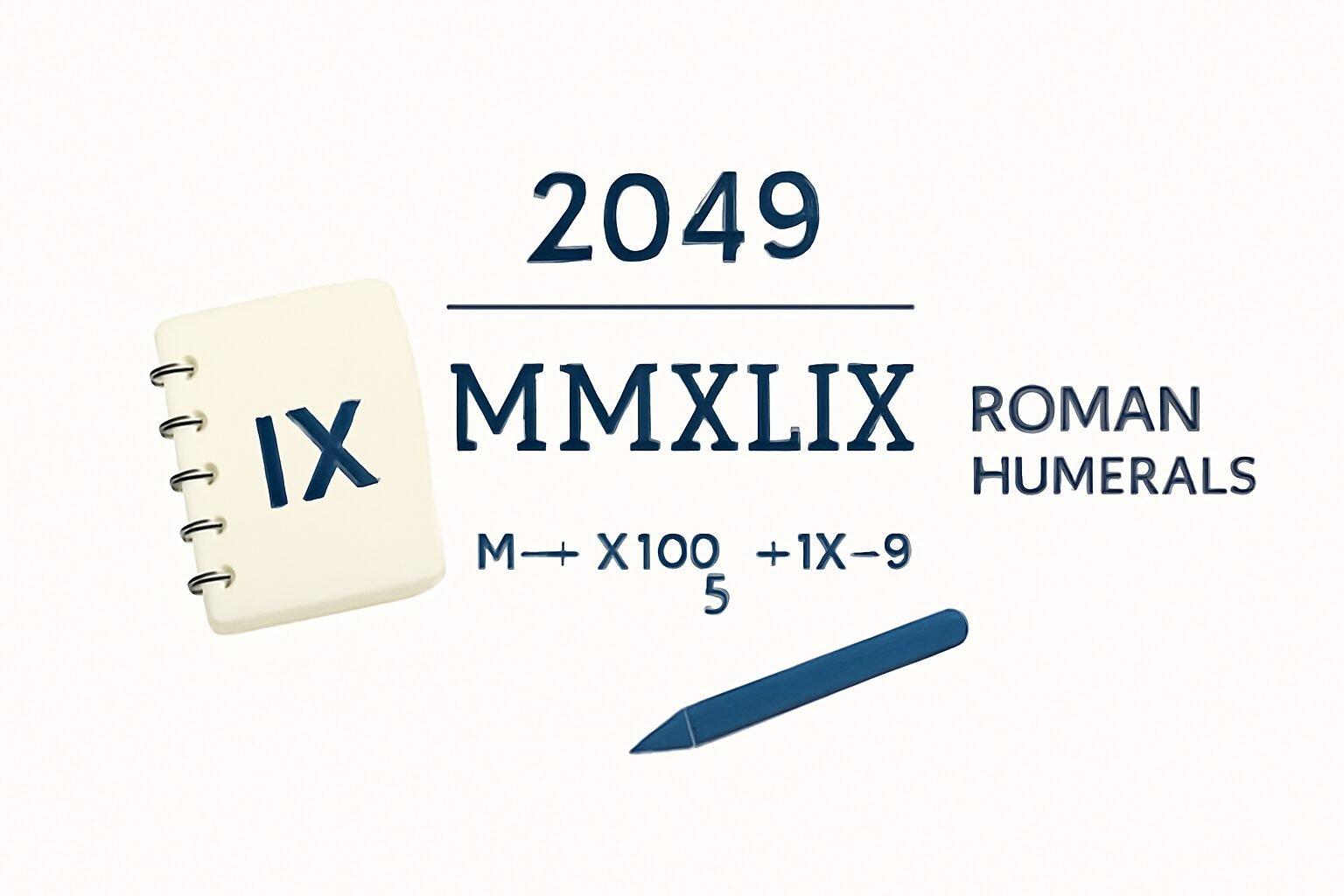
How to Convert 2049 into Roman Numerals
Roman numerals are made up of seven letters: I (1), V (5), X (10), L (50), C (100), D (500), and M (1000). To write a number like 2049, we combine these letters starting from the largest value and working down to the smallest.
Let's break 2049 into parts and build the Roman numeral step by step:
1000 fits into what's left of the number two times.
That means we add MM to our Roman numeral because two × one thousand equals 2000.
40 fits into what's left of the number one time.
That means we add XL to our Roman numeral because one × forty equals 40.
9 fits into what's left of the number one time.
That means we add IX to our Roman numeral because one × nine equals 9.
Final Answer
After combining all the parts, the Roman numeral for 2049 is:
MMXLIX
Tip: If a smaller numeral appears before a larger one (like IV), it means you subtract. If a smaller one comes after a larger one (like VI), it means you add. You'll see both styles when needed.
How to Convert the Roman Numeral MMXLIX into a Normal Number
To convert a Roman numeral to a normal number, we read it from left to right and add up the values of each symbol. However, if a smaller symbol appears before a larger one, we subtract the smaller value instead of adding it.
Let's break down MMXLIX step by step:
Step 1: We see M, which means we add one thousand (add 1000).
Step 2: We see M, which means we add one thousand (add 1000).
Step 3: We see XL, which means we subtract forty (subtract 40).
This is a subtraction case because X is smaller than L.
Step 4: We see IX, which means we subtract nine (subtract 9).
This is a subtraction case because I is smaller than X.
Total calculation: M (1000) + M (1000) + XL (40) + IX (9) = 2049
Final Answer
The normal number for the Roman numeral MMXLIX is:
2049
Tip: Remember the key rule. If a smaller numeral appears before a larger one (like IV), subtract the smaller value. If a smaller one comes after a larger one (like VI), add the values together.
What happened in the year 2049?
In the year 2049, the first crewed mission to Mars successfully landed and began constructing a permanent research habitat.
In the year 2049, a global treaty was signed to phase out single-use plastics entirely by 2055.
In the year 2049, AI-powered medical diagnostics became standard in hospitals, drastically reducing human error in early disease detection.
In the year 2049, the first commercial fusion power plant began supplying clean, limitless energy to a major city grid.
In the year 2049, a breakthrough in quantum computing allowed for the simulation of complex biological processes, accelerating drug discovery.
In the year 2049, the first underwater city, Aquatica, opened its doors to residents and tourists off the coast of Japan.