How to Convert 2055 into Roman Numerals
Roman numerals are made up of seven letters: I (1), V (5), X (10), L (50), C (100), D (500), and M (1000). To write a number like 2055, we combine these letters starting from the largest value and working down to the smallest.
Let's break 2055 into parts and build the Roman numeral step by step:
1000 fits into what's left of the number two times.
That means we add MM to our Roman numeral because two × one thousand equals 2000.
50 fits into what's left of the number one time.
That means we add L to our Roman numeral because one × fifty equals 50.
5 fits into what's left of the number one time.
That means we add V to our Roman numeral because one × five equals 5.
Final Answer
After combining all the parts, the Roman numeral for 2055 is:
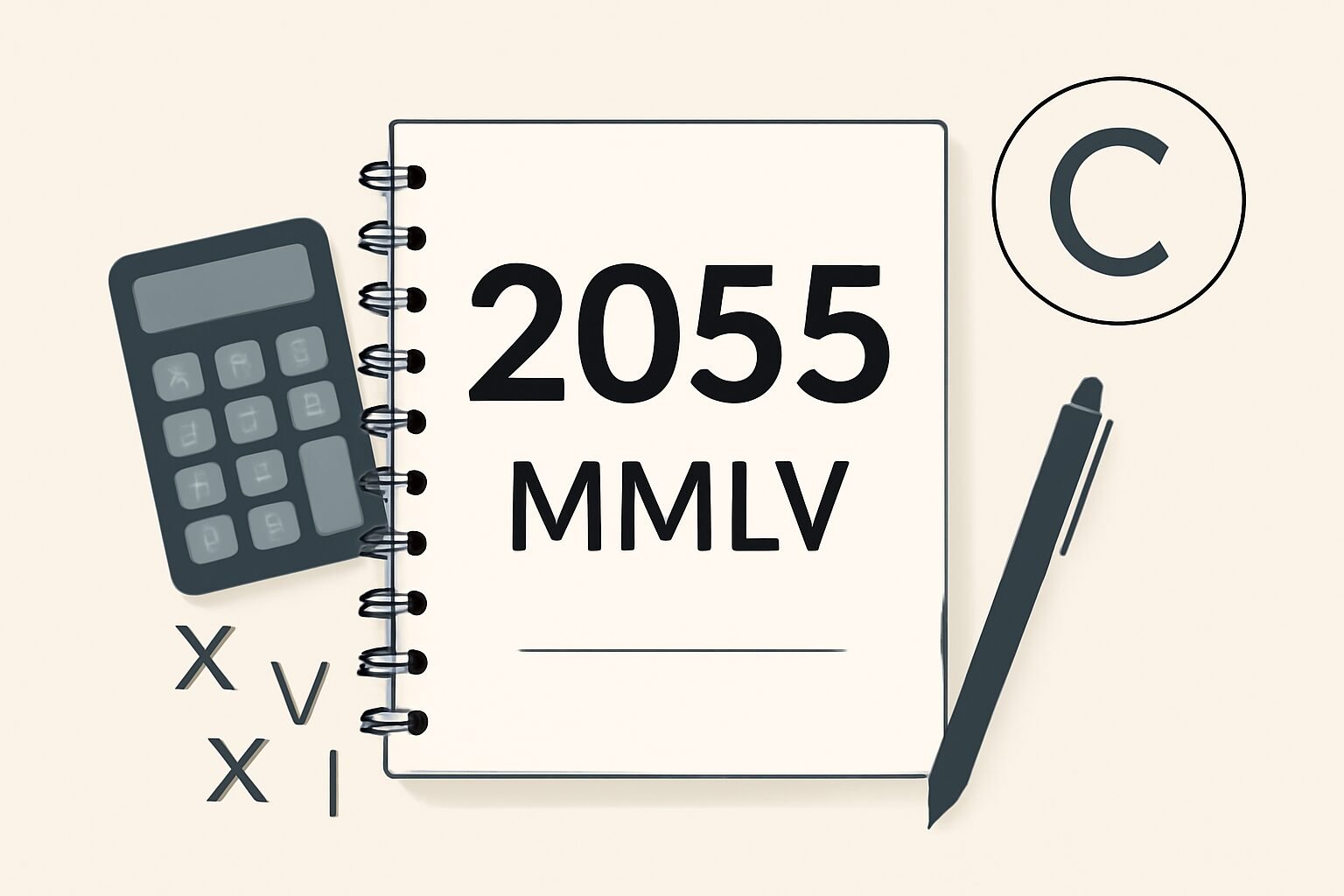
MMLV
Tip: If a smaller numeral appears before a larger one (like IV), it means you subtract. If a smaller one comes after a larger one (like VI), it means you add. You'll see both styles when needed.
How to Convert the Roman Numeral MMLV into a Normal Number
To convert a Roman numeral to a normal number, we read it from left to right and add up the values of each symbol. However, if a smaller symbol appears before a larger one, we subtract the smaller value instead of adding it.
Let's break down MMLV step by step:
Step 1: We see M, which means we add one thousand (add 1000).
Step 2: We see M, which means we add one thousand (add 1000).
Step 3: We see L, which means we add fifty (add 50).
Step 4: We see V, which means we add five (add 5).
Total calculation: M (1000) + M (1000) + L (50) + V (5) = 2055
Final Answer
The normal number for the Roman numeral MMLV is:
2055
Tip: Remember the key rule. If a smaller numeral appears before a larger one (like IV), subtract the smaller value. If a smaller one comes after a larger one (like VI), add the values together.
Number Analysis of 2055
What happened in the year 2055?
In the year 2055, the first permanent underwater research station was established in the Mariana Trench.
In the year 2055, commercial space flights to the Moon became available for private citizens.
In the year 2055, the global ban on single-use plastics was fully implemented, reducing ocean pollution significantly.
In the year 2055, AI-driven personalized education platforms became the standard in schools worldwide.
In the year 2055, the first successful teleportation of a complex organic molecule was achieved in a lab setting.