How to Convert 2100 into Roman Numerals
Roman numerals are made up of seven letters: I (1), V (5), X (10), L (50), C (100), D (500), and M (1000). To write a number like 2100, we combine these letters starting from the largest value and working down to the smallest.
Let's break 2100 into parts and build the Roman numeral step by step:
1000 fits into what's left of the number two times.
That means we add MM to our Roman numeral because two × one thousand equals 2000.
100 fits into what's left of the number one time.
That means we add C to our Roman numeral because one × one hundred equals 100.
Final Answer
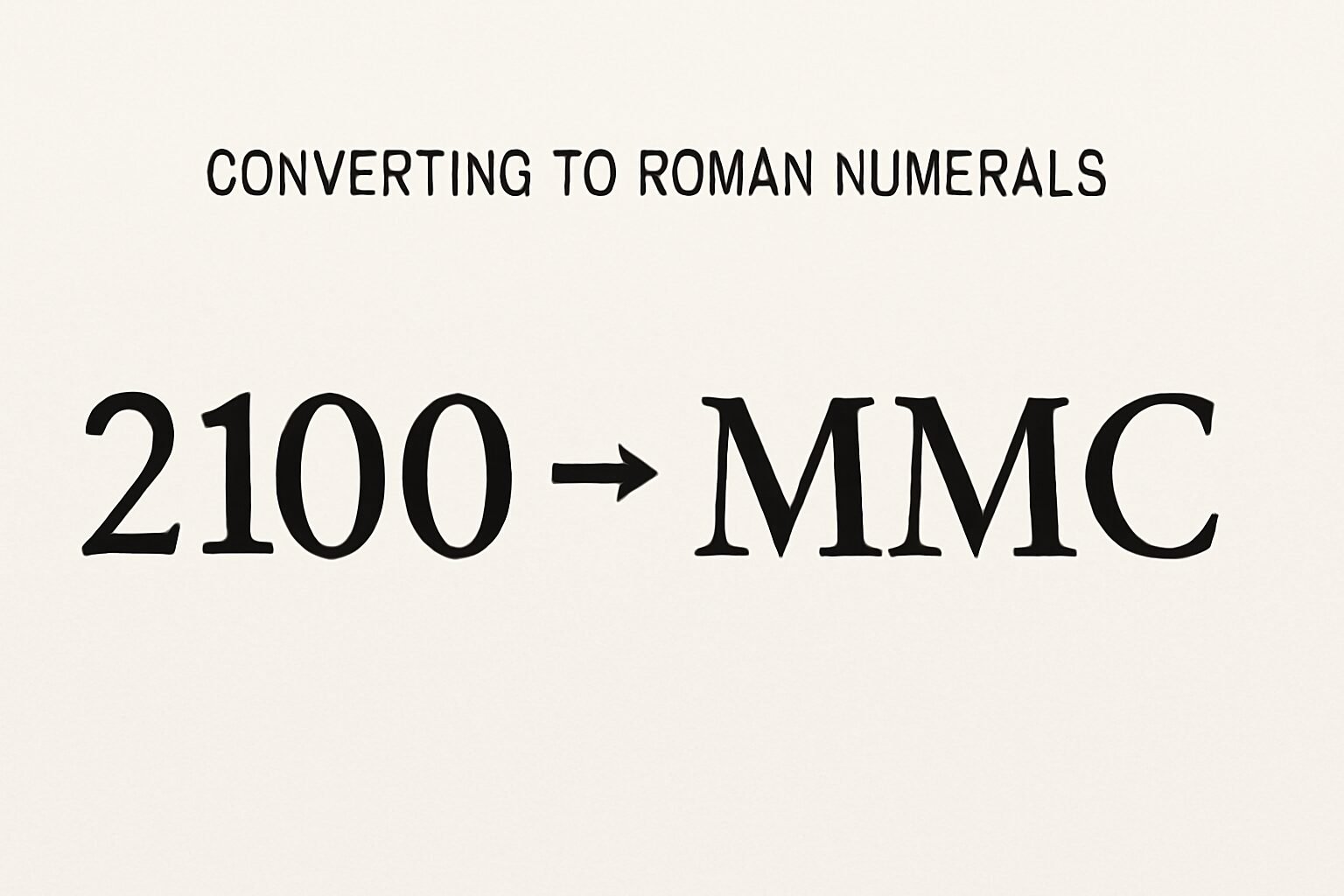
After combining all the parts, the Roman numeral for 2100 is:
MMC
Tip: If a smaller numeral appears before a larger one (like IV), it means you subtract. If a smaller one comes after a larger one (like VI), it means you add. You'll see both styles when needed.
How to Convert the Roman Numeral MMC into a Normal Number
To convert a Roman numeral to a normal number, we read it from left to right and add up the values of each symbol. However, if a smaller symbol appears before a larger one, we subtract the smaller value instead of adding it.
Let's break down MMC step by step:
Step 1: We see M, which means we add one thousand (add 1000).
Step 2: We see M, which means we add one thousand (add 1000).
Step 3: We see C, which means we add one hundred (add 100).
Total calculation: M (1000) + M (1000) + C (100) = 2100
Final Answer
The normal number for the Roman numeral MMC is:
2100
Tip: Remember the key rule. If a smaller numeral appears before a larger one (like IV), subtract the smaller value. If a smaller one comes after a larger one (like VI), add the values together.
Number Analysis of 2100
- Roman numeral: MMC
- Odd or even: Even
- Prime or composite: Composite
- Factors: 1, 2, 3, 4, 5, 6, 7, 10, 12, 14, 15, 20, 21, 25, 28, 30, 35, 42, 50, 60, 70, 75, 84, 100, 105, 140, 150, 175, 210, 300, 350, 420, 525, 700, 1050, 2100
- Square or cube: Neither (next square is 2116, next cube is 2197)
- Roman numeral length: 3 symbols
- Digit sum: 3
What happened in the year 2100?
In the year 2100, the first permanent human settlement on Mars celebrated its fifth anniversary with a live-streamed concert from the red planet.
In the year 2100, self-repairing infrastructure became standard in major cities, drastically reducing maintenance costs and improving urban resilience.
In the year 2100, the global average temperature stabilized for the first time in over a century, thanks to successful implementation of carbon-capture technologies.
In the year 2100, AI-powered personalized education platforms achieved near-universal literacy and numeracy rates worldwide.
In the year 2100, the first commercial fusion power plant began supplying clean, limitless energy to the European grid.