How to Convert 449 into Roman Numerals
Roman numerals are made up of seven letters: I (1), V (5), X (10), L (50), C (100), D (500), and M (1000). To write a number like 449, we combine these letters starting from the largest value and working down to the smallest.
Let's break 449 into parts and build the Roman numeral step by step:
400 fits into what's left of the number one time.
That means we add CD to our Roman numeral because one × four hundred equals 400.
40 fits into what's left of the number one time.
That means we add XL to our Roman numeral because one × forty equals 40.
9 fits into what's left of the number one time.
That means we add IX to our Roman numeral because one × nine equals 9.
Final Answer
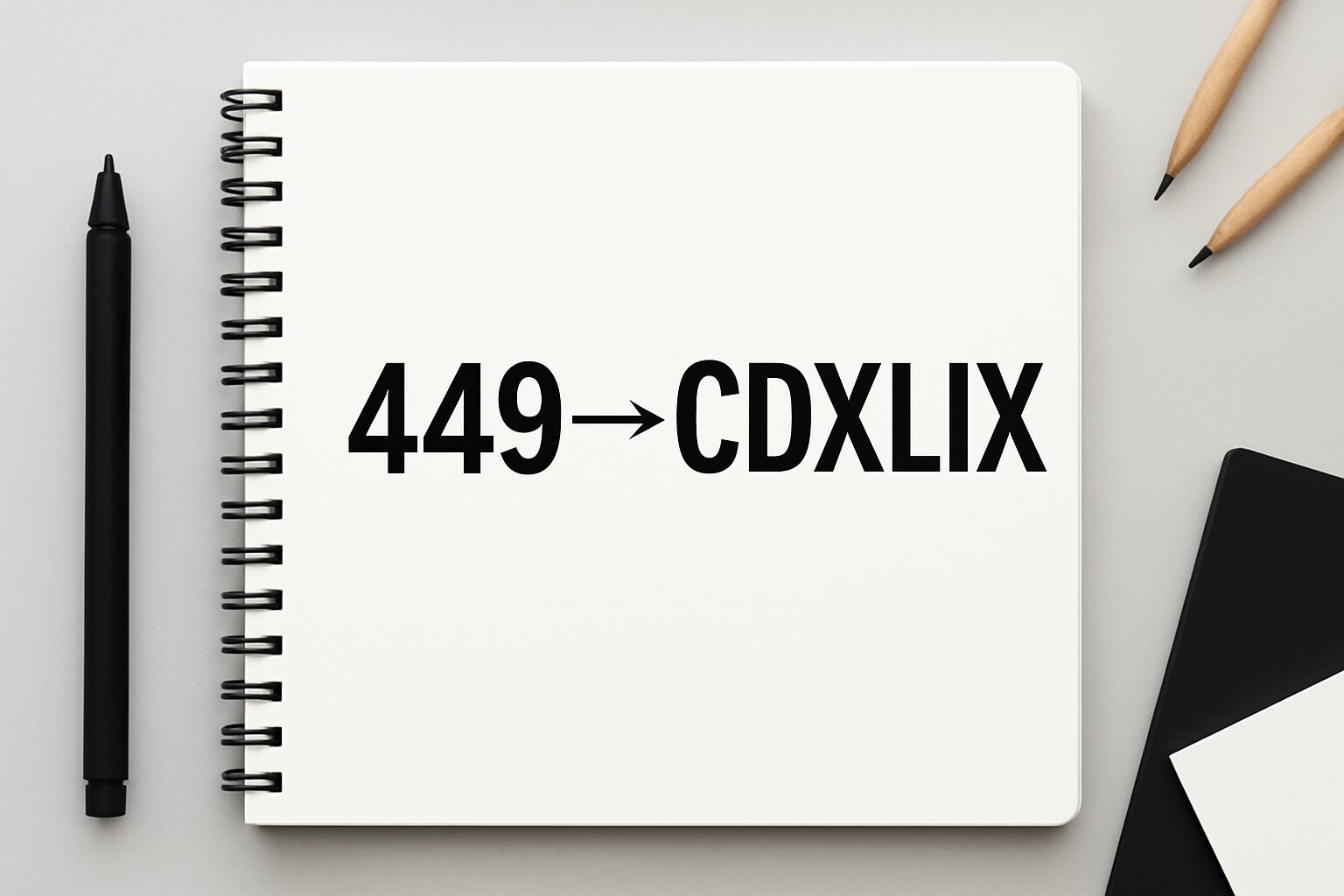
After combining all the parts, the Roman numeral for 449 is:
CDXLIX
Tip: If a smaller numeral appears before a larger one (like IV), it means you subtract. If a smaller one comes after a larger one (like VI), it means you add. You'll see both styles when needed.
How to Convert the Roman Numeral CDXLIX into a Normal Number
To convert a Roman numeral to a normal number, we read it from left to right and add up the values of each symbol. However, if a smaller symbol appears before a larger one, we subtract the smaller value instead of adding it.
Let's break down CDXLIX step by step:
Step 1: We see CD, which means we subtract four hundred (subtract 400).
This is a subtraction case because C is smaller than D.
Step 2: We see XL, which means we subtract forty (subtract 40).
This is a subtraction case because X is smaller than L.
Step 3: We see IX, which means we subtract nine (subtract 9).
This is a subtraction case because I is smaller than X.
Total calculation: CD (400) + XL (40) + IX (9) = 449
Final Answer
The normal number for the Roman numeral CDXLIX is:
449
Tip: Remember the key rule. If a smaller numeral appears before a larger one (like IV), subtract the smaller value. If a smaller one comes after a larger one (like VI), add the values together.
What happened in the year 449?
In the year 449, Hengist and Horsa, legendary leaders, are said to have arrived in Britain at the invitation of Vortigern to fight against the Picts.
In the year 449, the Anglo-Saxon settlement of Britain began, marking a significant period in early English history.
In the year 449, the Western Roman Empire continued to face internal strife and external pressures from invading tribes.