How to Convert 900 into Roman Numerals
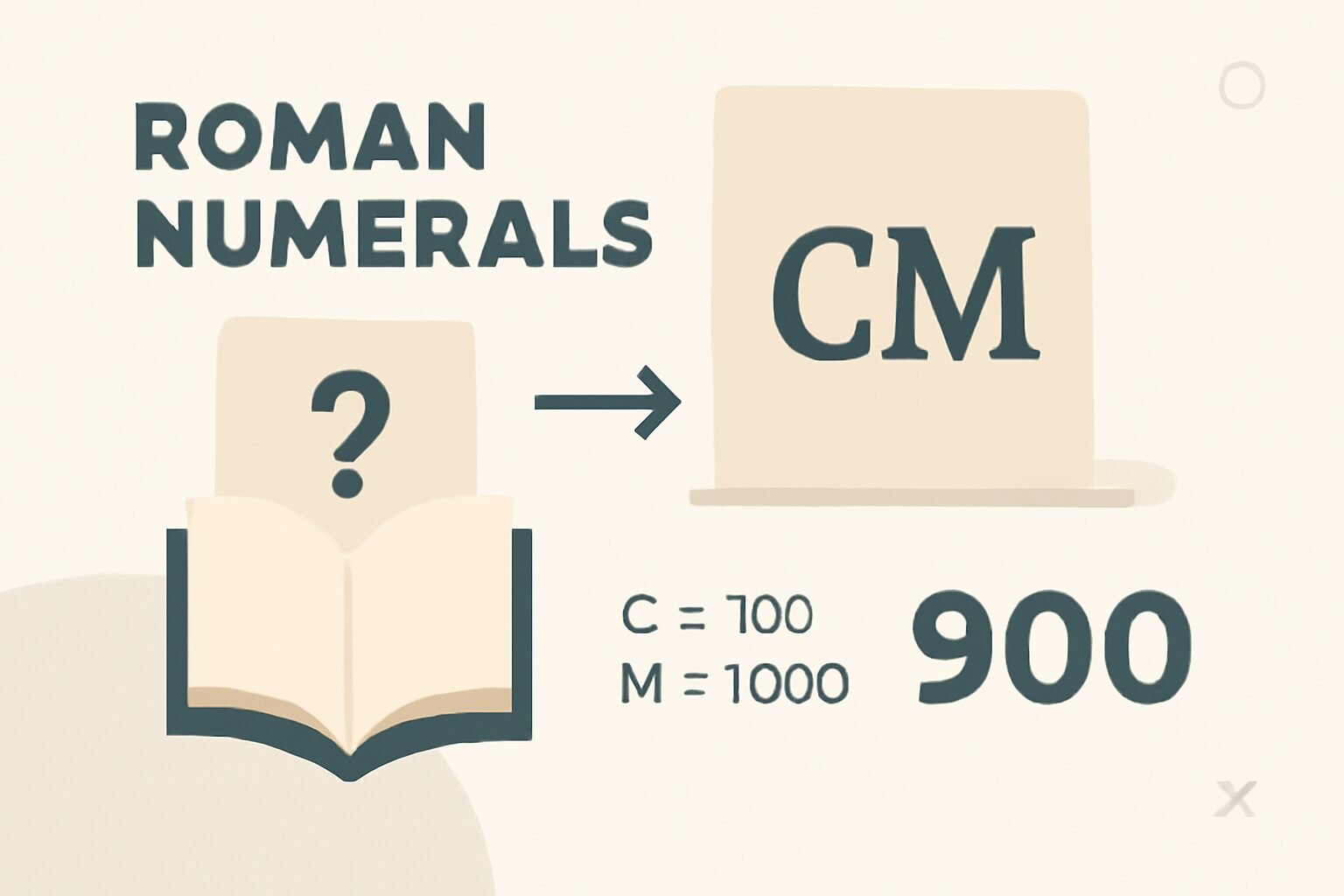
Roman numerals are made up of seven letters: I (1), V (5), X (10), L (50), C (100), D (500), and M (1000). To write a number like 900, we combine these letters starting from the largest value and working down to the smallest.
Let's break 900 into parts and build the Roman numeral step by step:
900 fits into what's left of the number one time.
That means we add CM to our Roman numeral because one × nine hundred equals 900.
Final Answer
After combining all the parts, the Roman numeral for 900 is:
CM
Tip: If a smaller numeral appears before a larger one (like IV), it means you subtract. If a smaller one comes after a larger one (like VI), it means you add. You'll see both styles when needed.
How to Convert the Roman Numeral CM into a Normal Number
To convert a Roman numeral to a normal number, we read it from left to right and add up the values of each symbol. However, if a smaller symbol appears before a larger one, we subtract the smaller value instead of adding it.
Let's break down CM step by step:
Step 1: We see CM, which means we subtract nine hundred (subtract 900).
This is a subtraction case because C is smaller than M.
Total calculation: CM (900) = 900
Final Answer
The normal number for the Roman numeral CM is:
900
Tip: Remember the key rule. If a smaller numeral appears before a larger one (like IV), subtract the smaller value. If a smaller one comes after a larger one (like VI), add the values together.
Number Analysis of 900
What happened in the year 900?
In the year 900, the Mayan city of Tikal was largely abandoned, marking the decline of its Classic Period.
In the year 900, the Byzantine Empire was under the rule of Emperor Leo VI the Wise, who promoted learning and legal reforms.
In the year 900, the Tang Dynasty in China continued to weaken, leading to increased regional fragmentation.
In the year 900, the Viking explorer Gunnbjörn Ulfsson sighted Greenland, though he did not land there.
In the year 900, the Kingdom of Asturias in northern Spain expanded under Alfonso III, consolidating Christian territories.
In the year 900, the construction of the temple complex at Prambanan in Java was likely completed, dedicated to Hindu deities.
In the year 900, the Abbasid Caliphate faced internal strife and the rise of independent emirates, weakening central authority.
In the year 900, the Carolingian Empire continued to fragment, with regional nobles gaining power over the weakened monarchy.
In the year 900, the city of Cordoba in Al-Andalus flourished as a major center of culture, science, and architecture.
In the year 900, the first use of gunpowder in warfare was recorded in China, though it was primarily used for fireworks and signals.