How to Convert 1006 into Roman Numerals
Roman numerals are made up of seven letters: I (1), V (5), X (10), L (50), C (100), D (500), and M (1000). To write a number like 1006, we combine these letters starting from the largest value and working down to the smallest.
Let's break 1006 into parts and build the Roman numeral step by step:
1000 fits into what's left of the number one time.
That means we add M to our Roman numeral because one × one thousand equals 1000.
5 fits into what's left of the number one time.
That means we add V to our Roman numeral because one × five equals 5.
1 fits into what's left of the number one time.
That means we add I to our Roman numeral because one × one equals 1.
Final Answer
After combining all the parts, the Roman numeral for 1006 is:
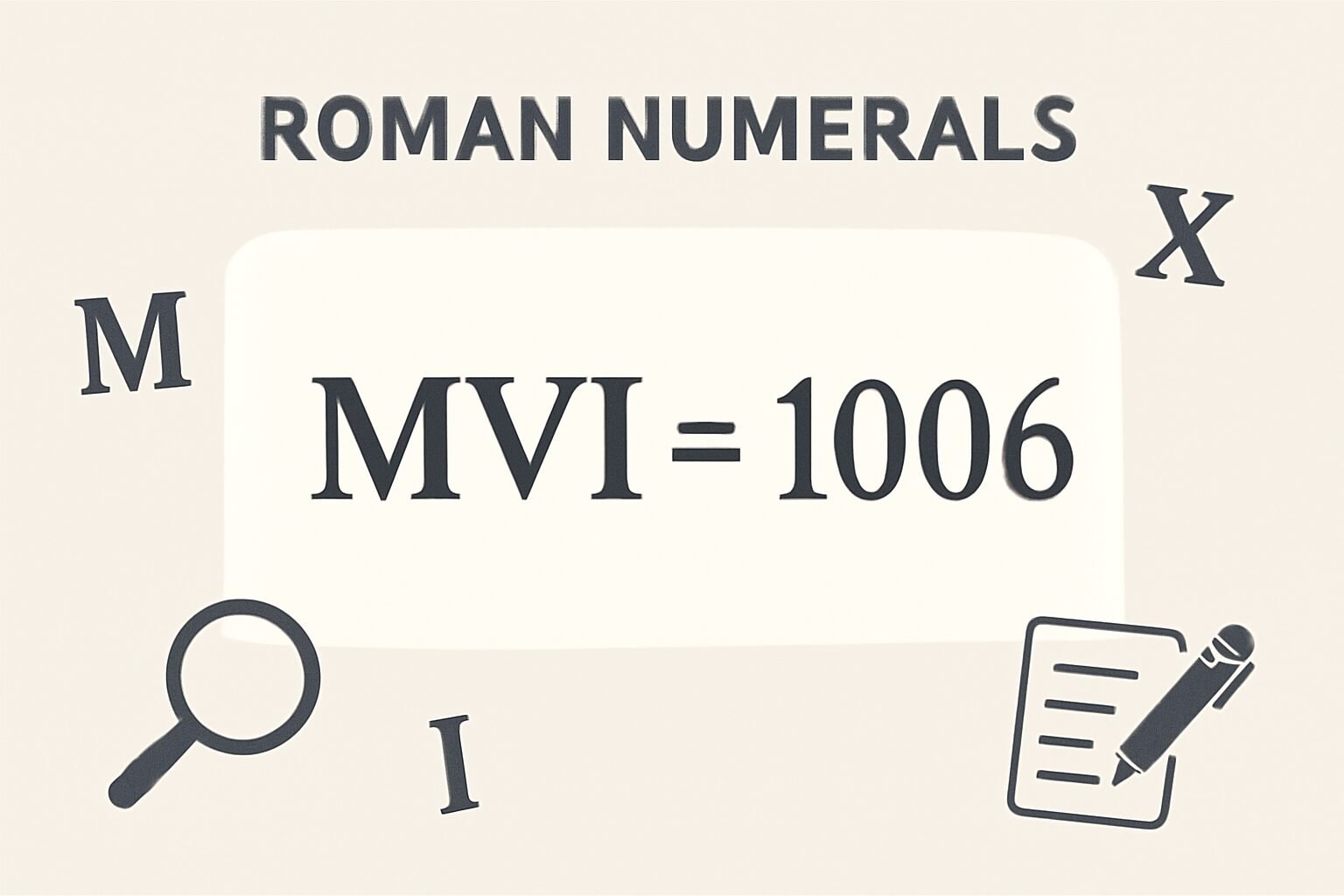
MVI
Tip: If a smaller numeral appears before a larger one (like IV), it means you subtract. If a smaller one comes after a larger one (like VI), it means you add. You'll see both styles when needed.
How to Convert the Roman Numeral MVI into a Normal Number
To convert a Roman numeral to a normal number, we read it from left to right and add up the values of each symbol. However, if a smaller symbol appears before a larger one, we subtract the smaller value instead of adding it.
Let's break down MVI step by step:
Step 1: We see M, which means we add one thousand (add 1000).
Step 2: We see V, which means we add five (add 5).
Step 3: We see I, which means we add one (add 1).
Total calculation: M (1000) + V (5) + I (1) = 1006
Final Answer
The normal number for the Roman numeral MVI is:
1006
Tip: Remember the key rule. If a smaller numeral appears before a larger one (like IV), subtract the smaller value. If a smaller one comes after a larger one (like VI), add the values together.
What happened in the year 1006?
In the year 1006, a supernova, now known as SN 1006, was observed by astronomers across the world, becoming one of the brightest stellar events in recorded history.
In the year 1006, the Fatimid Caliph Al-Hakim bi-Amr Allah ordered the destruction of the Church of the Holy Sepulchre in Jerusalem.
In the year 1006, the Battle of Cervera took place in the Iberian Peninsula, where Christian forces clashed with Muslim armies.
In the year 1006, the Japanese courtier and author Sei Shōnagon completed her famous work, "The Pillow Book," a collection of essays and observations.
In the year 1006, the Byzantine Empire under Basil II continued its military campaigns to secure and expand its territories in the Balkans.