How to Convert 1415 into Roman Numerals
Roman numerals are made up of seven letters: I (1), V (5), X (10), L (50), C (100), D (500), and M (1000). To write a number like 1415, we combine these letters starting from the largest value and working down to the smallest.
Let's break 1415 into parts and build the Roman numeral step by step:
1000 fits into what's left of the number one time.
That means we add M to our Roman numeral because one × one thousand equals 1000.
400 fits into what's left of the number one time.
That means we add CD to our Roman numeral because one × four hundred equals 400.
10 fits into what's left of the number one time.
That means we add X to our Roman numeral because one × ten equals 10.
5 fits into what's left of the number one time.
That means we add V to our Roman numeral because one × five equals 5.
Final Answer
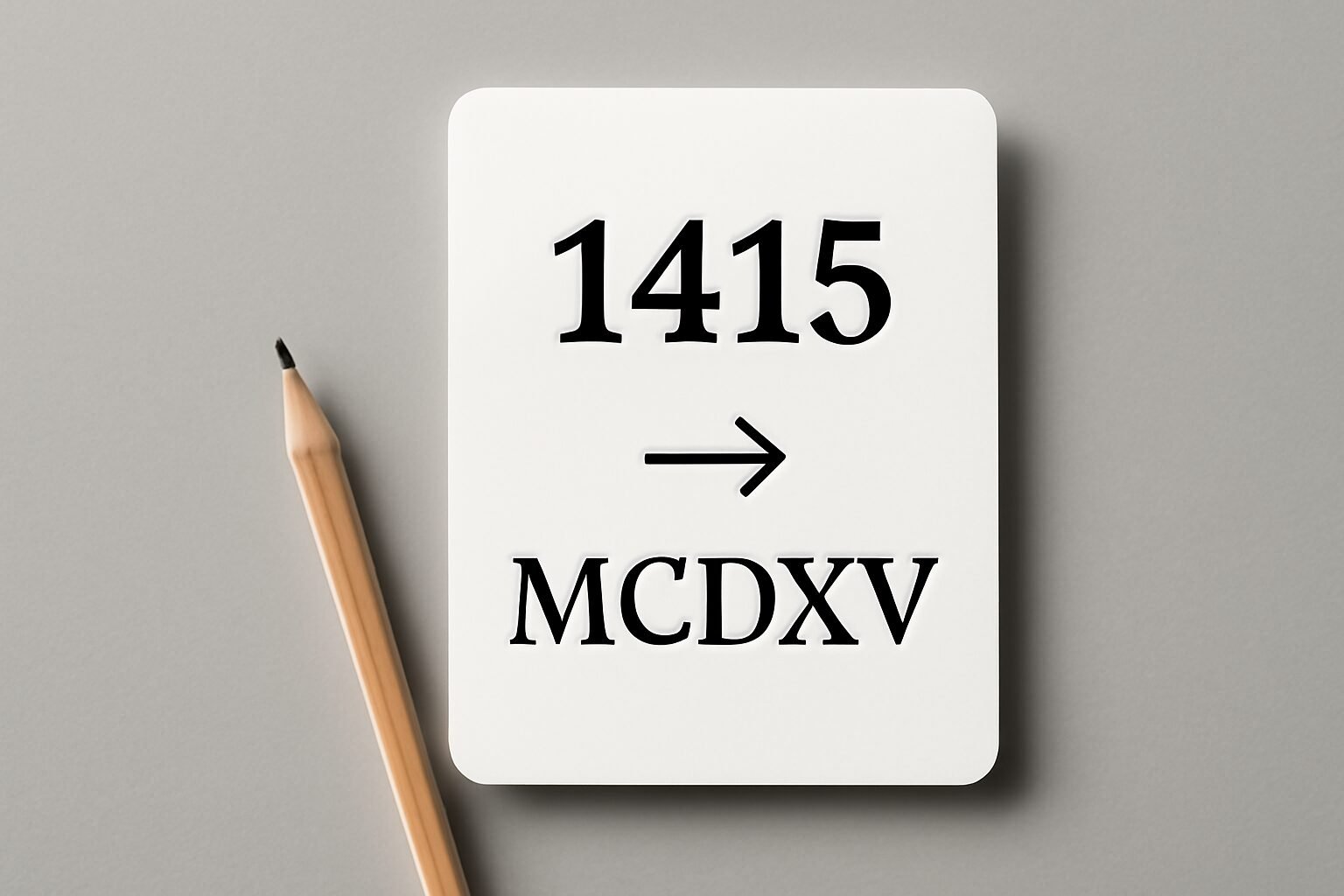
After combining all the parts, the Roman numeral for 1415 is:
MCDXV
Tip: If a smaller numeral appears before a larger one (like IV), it means you subtract. If a smaller one comes after a larger one (like VI), it means you add. You'll see both styles when needed.
How to Convert the Roman Numeral MCDXV into a Normal Number
To convert a Roman numeral to a normal number, we read it from left to right and add up the values of each symbol. However, if a smaller symbol appears before a larger one, we subtract the smaller value instead of adding it.
Let's break down MCDXV step by step:
Step 1: We see M, which means we add one thousand (add 1000).
Step 2: We see CD, which means we subtract four hundred (subtract 400).
This is a subtraction case because C is smaller than D.
Step 3: We see X, which means we add ten (add 10).
Step 4: We see V, which means we add five (add 5).
Total calculation: M (1000) + CD (400) + X (10) + V (5) = 1415
Final Answer
The normal number for the Roman numeral MCDXV is:
1415
Tip: Remember the key rule. If a smaller numeral appears before a larger one (like IV), subtract the smaller value. If a smaller one comes after a larger one (like VI), add the values together.
What happened in the year 1415?
In the year 1415, the Battle of Agincourt saw Henry V's English army achieve a decisive victory over the French.
In the year 1415, Portuguese forces captured the city of Ceuta in North Africa, marking the beginning of European overseas expansion.
In the year 1415, Jan Hus, a Czech religious reformer, was burned at the stake as a heretic after being condemned by the Council of Constance.
In the year 1415, the Medici family was officially recognized as bankers to the Papacy, strengthening their financial and political influence in Florence.
In the year 1415, the Yongle Emperor of the Ming Dynasty commissioned the construction of the Porcelain Tower of Nanjing, one of the wonders of the medieval world.