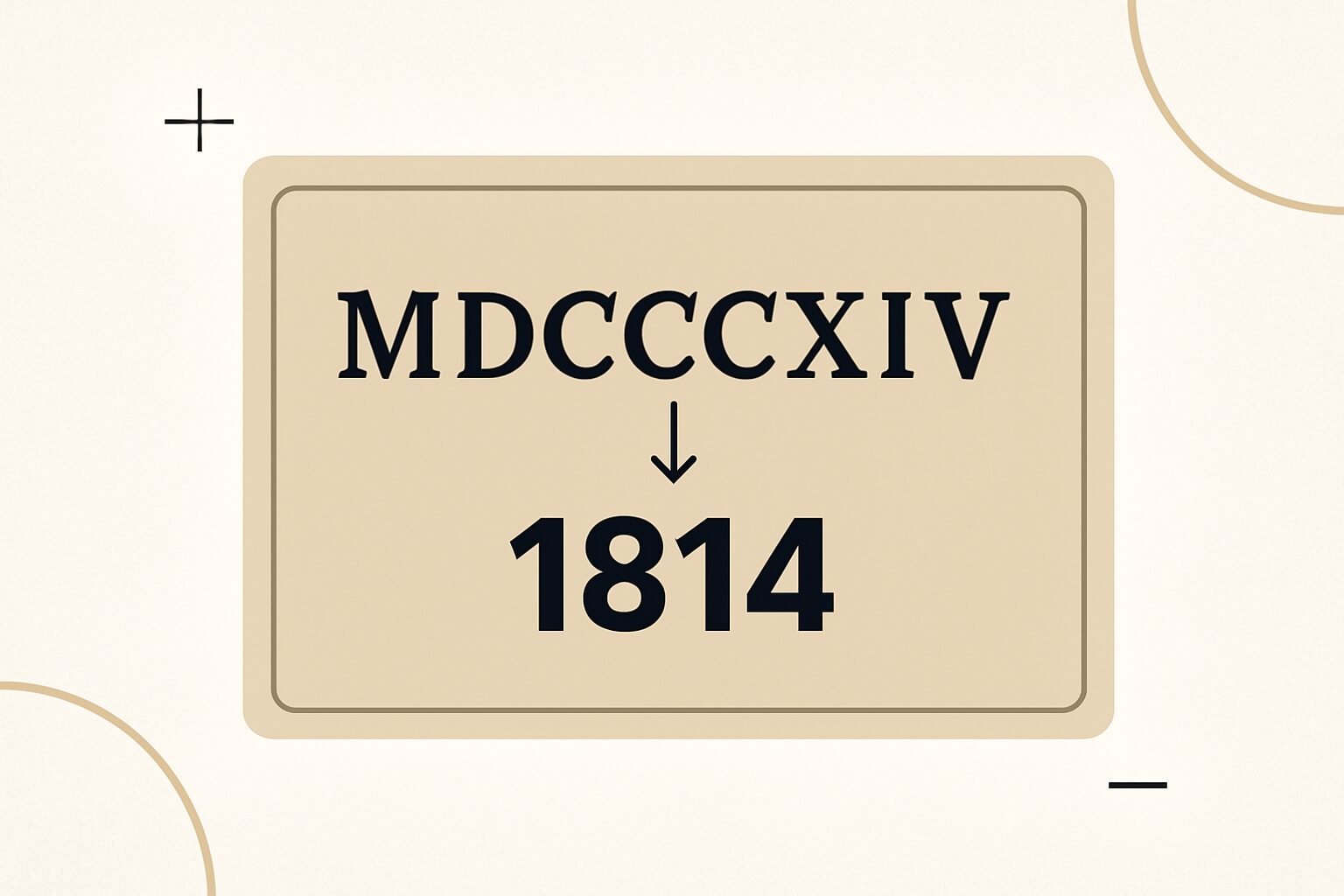
How to Convert 1814 into Roman Numerals
Roman numerals are made up of seven letters: I (1), V (5), X (10), L (50), C (100), D (500), and M (1000). To write a number like 1814, we combine these letters starting from the largest value and working down to the smallest.
Let's break 1814 into parts and build the Roman numeral step by step:
1000 fits into what's left of the number one time.
That means we add M to our Roman numeral because one × one thousand equals 1000.
500 fits into what's left of the number one time.
That means we add D to our Roman numeral because one × five hundred equals 500.
100 fits into what's left of the number three times.
That means we add CCC to our Roman numeral because three × one hundred equals 300.
10 fits into what's left of the number one time.
That means we add X to our Roman numeral because one × ten equals 10.
4 fits into what's left of the number one time.
That means we add IV to our Roman numeral because one × four equals 4.
Final Answer
After combining all the parts, the Roman numeral for 1814 is:
MDCCCXIV
Tip: If a smaller numeral appears before a larger one (like IV), it means you subtract. If a smaller one comes after a larger one (like VI), it means you add. You'll see both styles when needed.
How to Convert the Roman Numeral MDCCCXIV into a Normal Number
To convert a Roman numeral to a normal number, we read it from left to right and add up the values of each symbol. However, if a smaller symbol appears before a larger one, we subtract the smaller value instead of adding it.
Let's break down MDCCCXIV step by step:
Step 1: We see M, which means we add one thousand (add 1000).
Step 2: We see D, which means we add five hundred (add 500).
Step 3: We see C, which means we add one hundred (add 100).
Step 4: We see C, which means we add one hundred (add 100).
Step 5: We see C, which means we add one hundred (add 100).
Step 6: We see X, which means we add ten (add 10).
Step 7: We see IV, which means we subtract four (subtract 4).
This is a subtraction case because I is smaller than V.
Total calculation: M (1000) + D (500) + C (100) + C (100) + C (100) + X (10) + IV (4) = 1814
Final Answer
The normal number for the Roman numeral MDCCCXIV is:
1814
Tip: Remember the key rule. If a smaller numeral appears before a larger one (like IV), subtract the smaller value. If a smaller one comes after a larger one (like VI), add the values together.
Number Analysis of 1814
What happened in the year 1814?
In the year 1814, the Treaty of Fontainebleau was signed, forcing Napoleon Bonaparte to abdicate and exiling him to the island of Elba.
In the year 1814, the British army captured and burned Washington, D.C., including the White House and Capitol.
In the year 1814, the Congress of Vienna began, aiming to redraw the political map of Europe after the Napoleonic Wars.
In the year 1814, the poem "The Corsair" by Lord Byron was published and sold 10,000 copies on its first day.
In the year 1814, the first permanent gas light was installed in London at the Pelican Inn.
In the year 1814, the Battle of Horseshoe Bend took place, where Andrew Jackson defeated the Creek Indians.
In the year 1814, the first successful steam-powered printing press was patented by Friedrich Koenig and Andreas Bauer.
In the year 1814, the Treaty of Ghent was signed, ending the War of 1812 between the United States and Great Britain.