How to Convert 1852 into Roman Numerals
Roman numerals are made up of seven letters: I (1), V (5), X (10), L (50), C (100), D (500), and M (1000). To write a number like 1852, we combine these letters starting from the largest value and working down to the smallest.
Let's break 1852 into parts and build the Roman numeral step by step:
1000 fits into what's left of the number one time.
That means we add M to our Roman numeral because one × one thousand equals 1000.
500 fits into what's left of the number one time.
That means we add D to our Roman numeral because one × five hundred equals 500.
100 fits into what's left of the number three times.
That means we add CCC to our Roman numeral because three × one hundred equals 300.
50 fits into what's left of the number one time.
That means we add L to our Roman numeral because one × fifty equals 50.
1 fits into what's left of the number two times.
That means we add II to our Roman numeral because two × one equals 2.
Final Answer
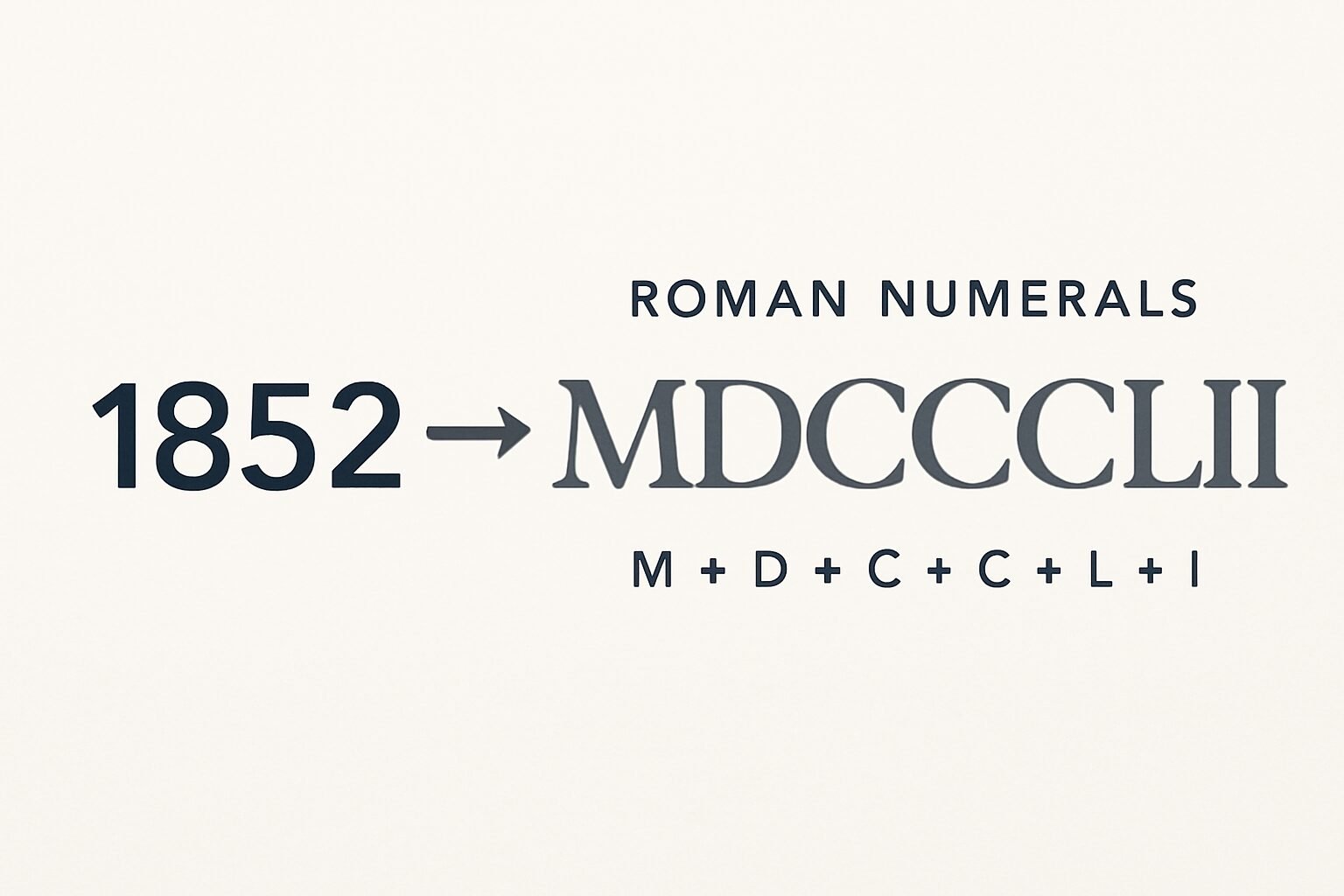
After combining all the parts, the Roman numeral for 1852 is:
MDCCCLII
Tip: If a smaller numeral appears before a larger one (like IV), it means you subtract. If a smaller one comes after a larger one (like VI), it means you add. You'll see both styles when needed.
How to Convert the Roman Numeral MDCCCLII into a Normal Number
To convert a Roman numeral to a normal number, we read it from left to right and add up the values of each symbol. However, if a smaller symbol appears before a larger one, we subtract the smaller value instead of adding it.
Let's break down MDCCCLII step by step:
Step 1: We see M, which means we add one thousand (add 1000).
Step 2: We see D, which means we add five hundred (add 500).
Step 3: We see C, which means we add one hundred (add 100).
Step 4: We see C, which means we add one hundred (add 100).
Step 5: We see C, which means we add one hundred (add 100).
Step 6: We see L, which means we add fifty (add 50).
Step 7: We see I, which means we add one (add 1).
Step 8: We see I, which means we add one (add 1).
Total calculation: M (1000) + D (500) + C (100) + C (100) + C (100) + L (50) + I (1) + I (1) = 1852
Final Answer
The normal number for the Roman numeral MDCCCLII is:
1852
Tip: Remember the key rule. If a smaller numeral appears before a larger one (like IV), subtract the smaller value. If a smaller one comes after a larger one (like VI), add the values together.
Number Analysis of 1852
What happened in the year 1852?
In the year 1852, Harriet Beecher Stowe published the influential novel "Uncle Tom's Cabin," which intensified anti-slavery sentiments in the United States.
In the year 1852, the first public flushing toilet was installed in a London street, improving urban sanitation.
In the year 1852, the New York and Mississippi Valley Printing Telegraph Company was founded, later becoming Western Union.
In the year 1852, the first edition of "Roget's Thesaurus" was published, providing a comprehensive collection of English synonyms.
In the year 1852, the Second French Empire was established, with Napoleon III proclaimed Emperor of France.
In the year 1852, the first successful aerial photograph was taken from a balloon over Boston by James Wallace Black.
In the year 1852, the first British public library opened in Manchester under the Public Libraries Act of 1850.
In the year 1852, the Taiping Rebellion continued to devastate China, leading to massive loss of life and social upheaval.
In the year 1852, the first issue of "The Illustrated London News" featured a Christmas supplement, popularizing the tradition of holiday editions.
In the year 1852, the first horse-drawn tramway in Europe began operation in Paris, improving urban transport.