How to Convert 1858 into Roman Numerals
Roman numerals are made up of seven letters: I (1), V (5), X (10), L (50), C (100), D (500), and M (1000). To write a number like 1858, we combine these letters starting from the largest value and working down to the smallest.
Let's break 1858 into parts and build the Roman numeral step by step:
1000 fits into what's left of the number one time.
That means we add M to our Roman numeral because one × one thousand equals 1000.
500 fits into what's left of the number one time.
That means we add D to our Roman numeral because one × five hundred equals 500.
100 fits into what's left of the number three times.
That means we add CCC to our Roman numeral because three × one hundred equals 300.
50 fits into what's left of the number one time.
That means we add L to our Roman numeral because one × fifty equals 50.
5 fits into what's left of the number one time.
That means we add V to our Roman numeral because one × five equals 5.
1 fits into what's left of the number three times.
That means we add III to our Roman numeral because three × one equals 3.
Final Answer
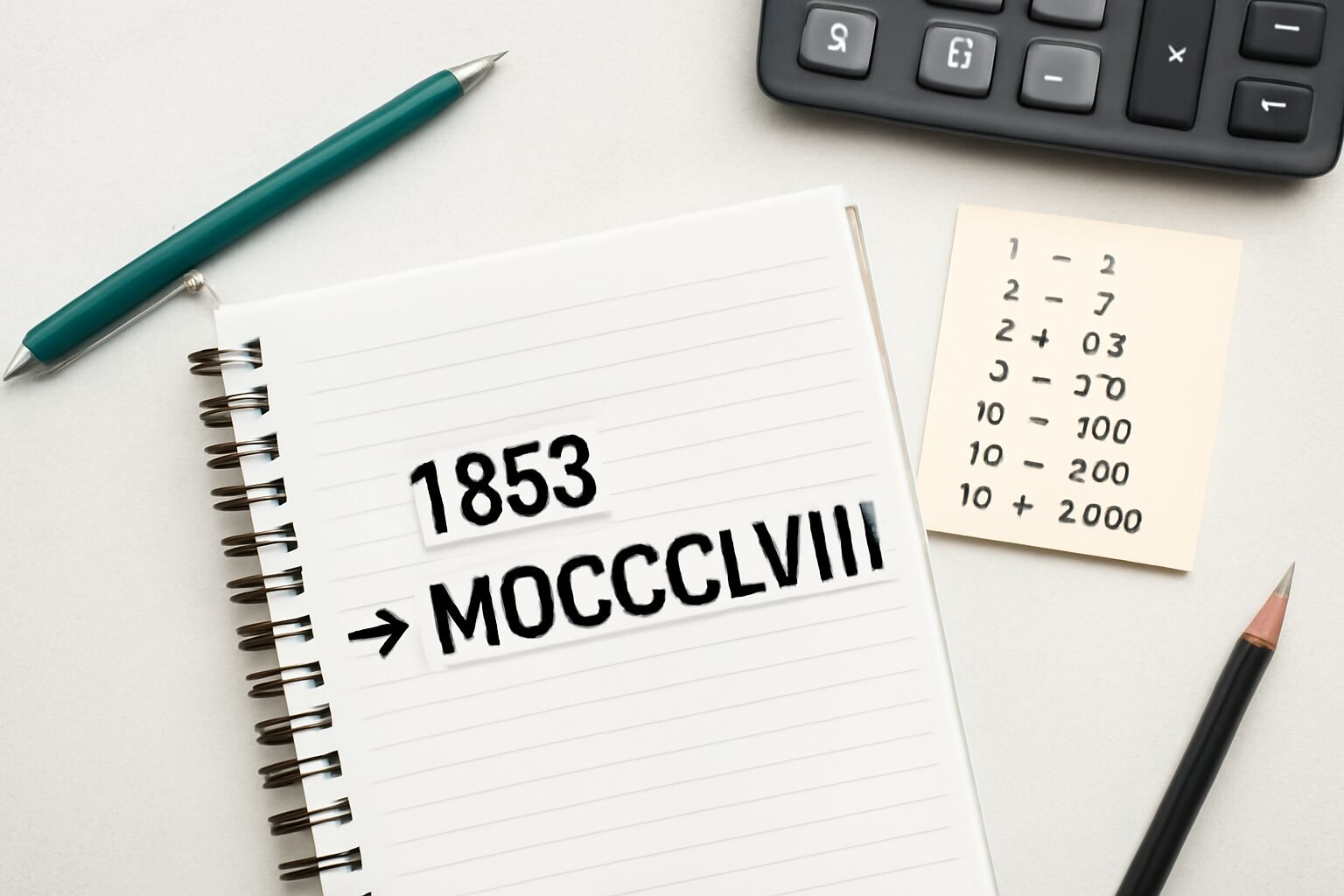
After combining all the parts, the Roman numeral for 1858 is:
MDCCCLVIII
Tip: If a smaller numeral appears before a larger one (like IV), it means you subtract. If a smaller one comes after a larger one (like VI), it means you add. You'll see both styles when needed.
How to Convert the Roman Numeral MDCCCLVIII into a Normal Number
To convert a Roman numeral to a normal number, we read it from left to right and add up the values of each symbol. However, if a smaller symbol appears before a larger one, we subtract the smaller value instead of adding it.
Let's break down MDCCCLVIII step by step:
Step 1: We see M, which means we add one thousand (add 1000).
Step 2: We see D, which means we add five hundred (add 500).
Step 3: We see C, which means we add one hundred (add 100).
Step 4: We see C, which means we add one hundred (add 100).
Step 5: We see C, which means we add one hundred (add 100).
Step 6: We see L, which means we add fifty (add 50).
Step 7: We see V, which means we add five (add 5).
Step 8: We see I, which means we add one (add 1).
Step 9: We see I, which means we add one (add 1).
Step 10: We see I, which means we add one (add 1).
Total calculation: M (1000) + D (500) + C (100) + C (100) + C (100) + L (50) + V (5) + I (1) + I (1) + I (1) = 1858
Final Answer
The normal number for the Roman numeral MDCCCLVIII is:
1858
Tip: Remember the key rule. If a smaller numeral appears before a larger one (like IV), subtract the smaller value. If a smaller one comes after a larger one (like VI), add the values together.
Number Analysis of 1858
What happened in the year 1858?
In the year 1858, the first transatlantic telegraph cable was successfully laid, connecting North America and Europe.
In the year 1858, the Treaty of Aigun was signed between Russia and China, establishing the modern border along the Amur River.
In the year 1858, the first stagecoach robbery of the famous outlaw, "Black Bart," occurred in California.
In the year 1858, the Great Stink overwhelmed London, leading to the construction of a modern sewer system.
In the year 1858, the first-ever intercollegiate baseball game was played between Amherst and Williams colleges.
In the year 1858, the Lincoln-Douglas debates took place in Illinois, drawing national attention to the issue of slavery.
In the year 1858, the first aerial photograph was taken by French photographer Nadar from a hot air balloon.
In the year 1858, the British government took direct control of India from the East India Company following the Indian Rebellion of 1857.
In the year 1858, the first life insurance policy for women was issued in the United States.
In the year 1858, the first performance of the opera "Orpheus in the Underworld" by Jacques Offenbach introduced the can-can dance to the world.