How to Convert 1884 into Roman Numerals
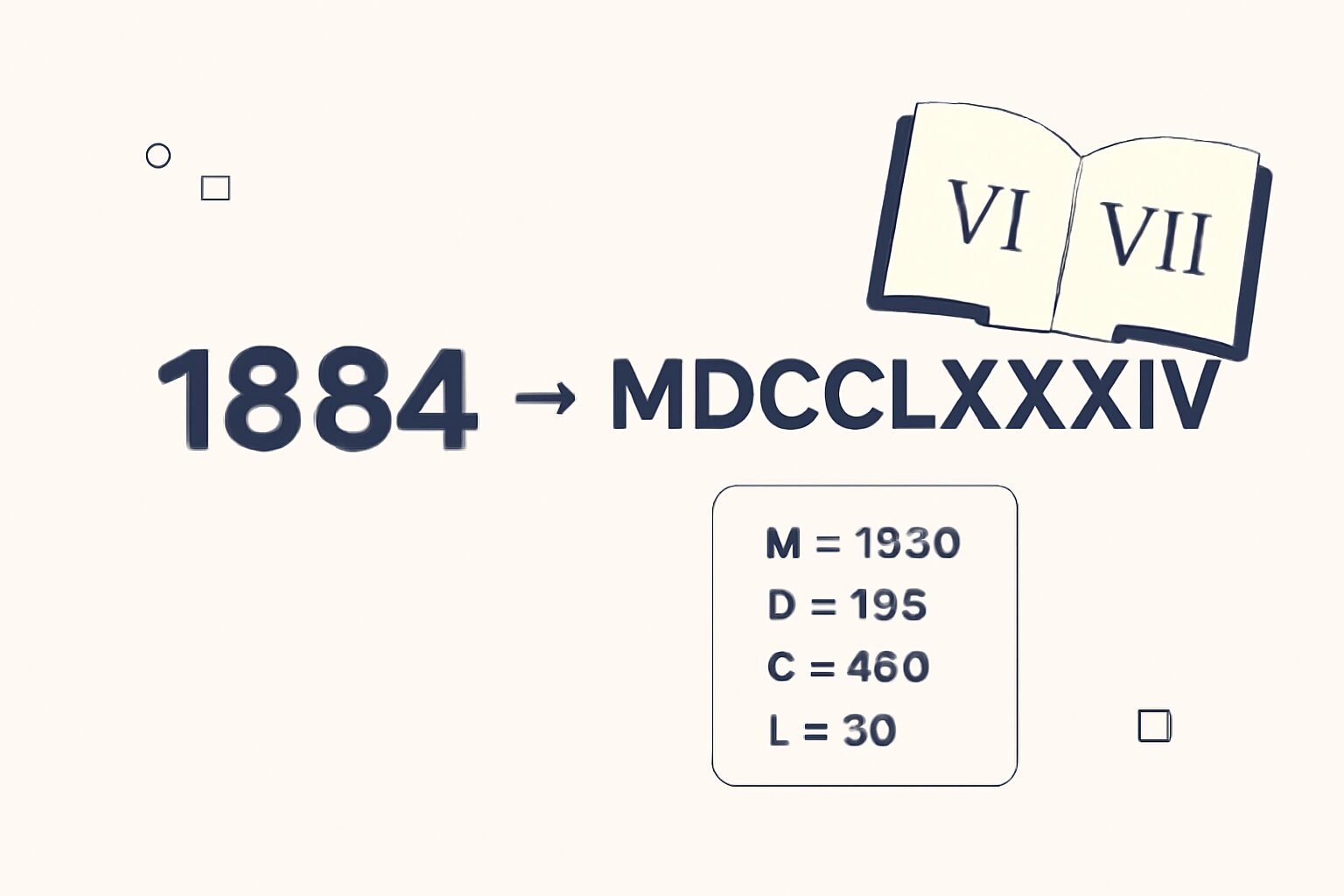
Roman numerals are made up of seven letters: I (1), V (5), X (10), L (50), C (100), D (500), and M (1000). To write a number like 1884, we combine these letters starting from the largest value and working down to the smallest.
Let's break 1884 into parts and build the Roman numeral step by step:
1000 fits into what's left of the number one time.
That means we add M to our Roman numeral because one × one thousand equals 1000.
500 fits into what's left of the number one time.
That means we add D to our Roman numeral because one × five hundred equals 500.
100 fits into what's left of the number three times.
That means we add CCC to our Roman numeral because three × one hundred equals 300.
50 fits into what's left of the number one time.
That means we add L to our Roman numeral because one × fifty equals 50.
10 fits into what's left of the number three times.
That means we add XXX to our Roman numeral because three × ten equals 30.
4 fits into what's left of the number one time.
That means we add IV to our Roman numeral because one × four equals 4.
Final Answer
After combining all the parts, the Roman numeral for 1884 is:
MDCCCLXXXIV
Tip: If a smaller numeral appears before a larger one (like IV), it means you subtract. If a smaller one comes after a larger one (like VI), it means you add. You'll see both styles when needed.
How to Convert the Roman Numeral MDCCCLXXXIV into a Normal Number
To convert a Roman numeral to a normal number, we read it from left to right and add up the values of each symbol. However, if a smaller symbol appears before a larger one, we subtract the smaller value instead of adding it.
Let's break down MDCCCLXXXIV step by step:
Step 1: We see M, which means we add one thousand (add 1000).
Step 2: We see D, which means we add five hundred (add 500).
Step 3: We see C, which means we add one hundred (add 100).
Step 4: We see C, which means we add one hundred (add 100).
Step 5: We see C, which means we add one hundred (add 100).
Step 6: We see L, which means we add fifty (add 50).
Step 7: We see X, which means we add ten (add 10).
Step 8: We see X, which means we add ten (add 10).
Step 9: We see X, which means we add ten (add 10).
Step 10: We see IV, which means we subtract four (subtract 4).
This is a subtraction case because I is smaller than V.
Total calculation: M (1000) + D (500) + C (100) + C (100) + C (100) + L (50) + X (10) + X (10) + X (10) + IV (4) = 1884
Final Answer
The normal number for the Roman numeral MDCCCLXXXIV is:
1884
Tip: Remember the key rule. If a smaller numeral appears before a larger one (like IV), subtract the smaller value. If a smaller one comes after a larger one (like VI), add the values together.
Number Analysis of 1884
What happened in the year 1884?
In the year 1884, the Washington Monument was completed and dedicated in Washington, D.C.
In the year 1884, the Greenwich Meridian was established as the prime meridian for longitude and timekeeping.
In the year 1884, Mark Twain published his classic novel "Adventures of Huckleberry Finn."
In the year 1884, the first roller coaster in America opened at Coney Island, New York.
In the year 1884, Grover Cleveland was elected as the 22nd President of the United States.
In the year 1884, the Siege of Khartoum began during the Mahdist War in Sudan.
In the year 1884, the first long-distance telephone call was made between Boston and New York City.
In the year 1884, the Fabian Society was founded in London to promote socialist ideals through gradual reform.
In the year 1884, the Dow Jones Transportation Average, the oldest stock market index, was first published.
In the year 1884, the German Empire established a protectorate over South West Africa (now Namibia).