How to Convert 2838 into Roman Numerals
Roman numerals are made up of seven letters: I (1), V (5), X (10), L (50), C (100), D (500), and M (1000). To write a number like 2838, we combine these letters starting from the largest value and working down to the smallest.
Let's break 2838 into parts and build the Roman numeral step by step:
1000 fits into what's left of the number two times.
That means we add MM to our Roman numeral because two × one thousand equals 2000.
500 fits into what's left of the number one time.
That means we add D to our Roman numeral because one × five hundred equals 500.
100 fits into what's left of the number three times.
That means we add CCC to our Roman numeral because three × one hundred equals 300.
10 fits into what's left of the number three times.
That means we add XXX to our Roman numeral because three × ten equals 30.
5 fits into what's left of the number one time.
That means we add V to our Roman numeral because one × five equals 5.
1 fits into what's left of the number three times.
That means we add III to our Roman numeral because three × one equals 3.
Final Answer
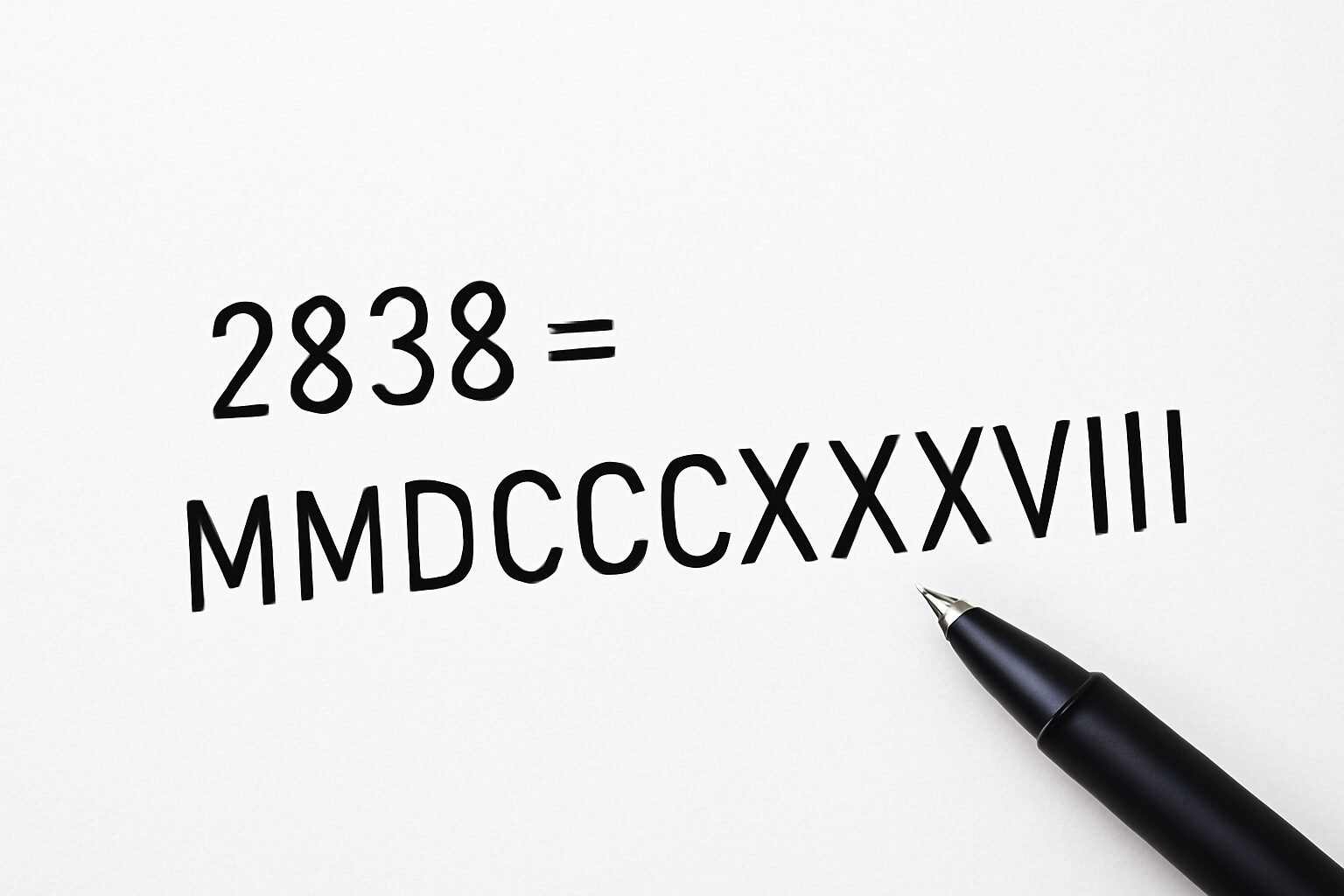
After combining all the parts, the Roman numeral for 2838 is:
MMDCCCXXXVIII
Tip: If a smaller numeral appears before a larger one (like IV), it means you subtract. If a smaller one comes after a larger one (like VI), it means you add. You'll see both styles when needed.
How to Convert the Roman Numeral MMDCCCXXXVIII into a Normal Number
To convert a Roman numeral to a normal number, we read it from left to right and add up the values of each symbol. However, if a smaller symbol appears before a larger one, we subtract the smaller value instead of adding it.
Let's break down MMDCCCXXXVIII step by step:
Step 1: We see M, which means we add one thousand (add 1000).
Step 2: We see M, which means we add one thousand (add 1000).
Step 3: We see D, which means we add five hundred (add 500).
Step 4: We see C, which means we add one hundred (add 100).
Step 5: We see C, which means we add one hundred (add 100).
Step 6: We see C, which means we add one hundred (add 100).
Step 7: We see X, which means we add ten (add 10).
Step 8: We see X, which means we add ten (add 10).
Step 9: We see X, which means we add ten (add 10).
Step 10: We see V, which means we add five (add 5).
Step 11: We see I, which means we add one (add 1).
Step 12: We see I, which means we add one (add 1).
Step 13: We see I, which means we add one (add 1).
Total calculation: M (1000) + M (1000) + D (500) + C (100) + C (100) + C (100) + X (10) + X (10) + X (10) + V (5) + I (1) + I (1) + I (1) = 2838
Final Answer
The normal number for the Roman numeral MMDCCCXXXVIII is:
2838
Tip: Remember the key rule. If a smaller numeral appears before a larger one (like IV), subtract the smaller value. If a smaller one comes after a larger one (like VI), add the values together.
Number Analysis of 2838
What happened in the year 2838?
In the year 2838, the first successful terraforming of a moon in the Andromeda Galaxy was completed, allowing for human colonization.
In the year 2838, the Interstellar Olympic Games were hosted on Mars, featuring new zero-gravity sports.
In the year 2838, scientists discovered a method for instantaneous communication across any distance, revolutionizing galactic diplomacy.
In the year 2838, the annual Galactic Art Festival showcased holographic masterpieces from over 500 inhabited planets.
In the year 2838, a new species of silicon-based life was found thriving in the acidic clouds of Venus.