How to Convert 58 into Roman Numerals
Roman numerals are made up of seven letters: I (1), V (5), X (10), L (50), C (100), D (500), and M (1000). To write a number like 58, we combine these letters starting from the largest value and working down to the smallest.
Let's break 58 into parts and build the Roman numeral step by step:
50 fits into what's left of the number one time.
That means we add L to our Roman numeral because one × fifty equals 50.
5 fits into what's left of the number one time.
That means we add V to our Roman numeral because one × five equals 5.
1 fits into what's left of the number three times.
That means we add III to our Roman numeral because three × one equals 3.
Final Answer
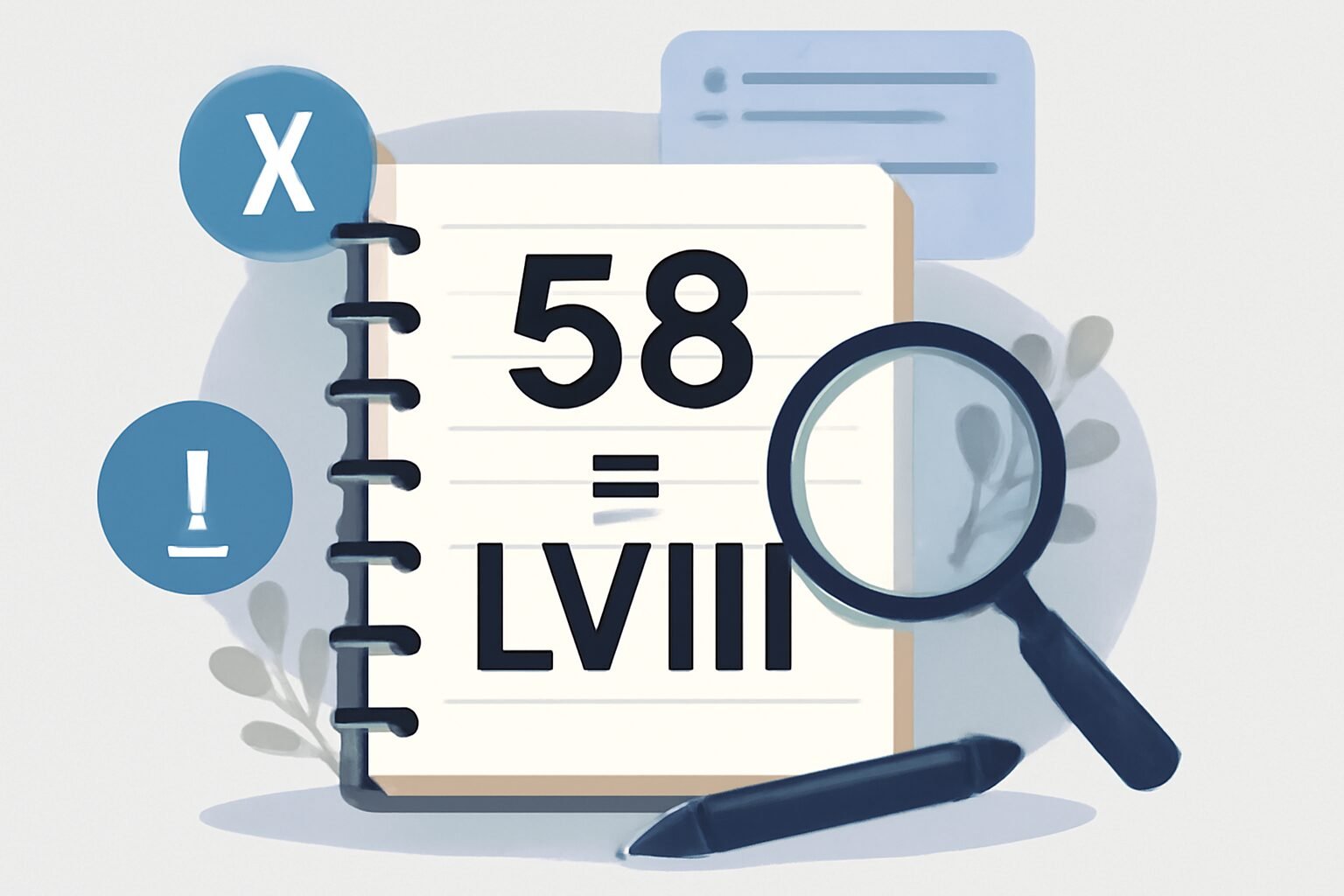
After combining all the parts, the Roman numeral for 58 is:
LVIII
Tip: If a smaller numeral appears before a larger one (like IV), it means you subtract. If a smaller one comes after a larger one (like VI), it means you add. You'll see both styles when needed.
How to Convert the Roman Numeral LVIII into a Normal Number
To convert a Roman numeral to a normal number, we read it from left to right and add up the values of each symbol. However, if a smaller symbol appears before a larger one, we subtract the smaller value instead of adding it.
Let's break down LVIII step by step:
Step 1: We see L, which means we add fifty (add 50).
Step 2: We see V, which means we add five (add 5).
Step 3: We see I, which means we add one (add 1).
Step 4: We see I, which means we add one (add 1).
Step 5: We see I, which means we add one (add 1).
Total calculation: L (50) + V (5) + I (1) + I (1) + I (1) = 58
Final Answer
The normal number for the Roman numeral LVIII is:
58
Tip: Remember the key rule. If a smaller numeral appears before a larger one (like IV), subtract the smaller value. If a smaller one comes after a larger one (like VI), add the values together.
What happened in the year 58?
In the year 58, Emperor Nero ordered the construction of a new wooden amphitheater in Rome.
In the year 58, Roman general Gnaeus Domitius Corbulo campaigned successfully against the Parthians in Armenia.
In the year 58, the Apostle Paul wrote his Epistle to the Romans while in Corinth.
In the year 58, the Roman province of Britannia saw increased military activity under governor Quintus Veranius.