How to Convert 1511 into Roman Numerals
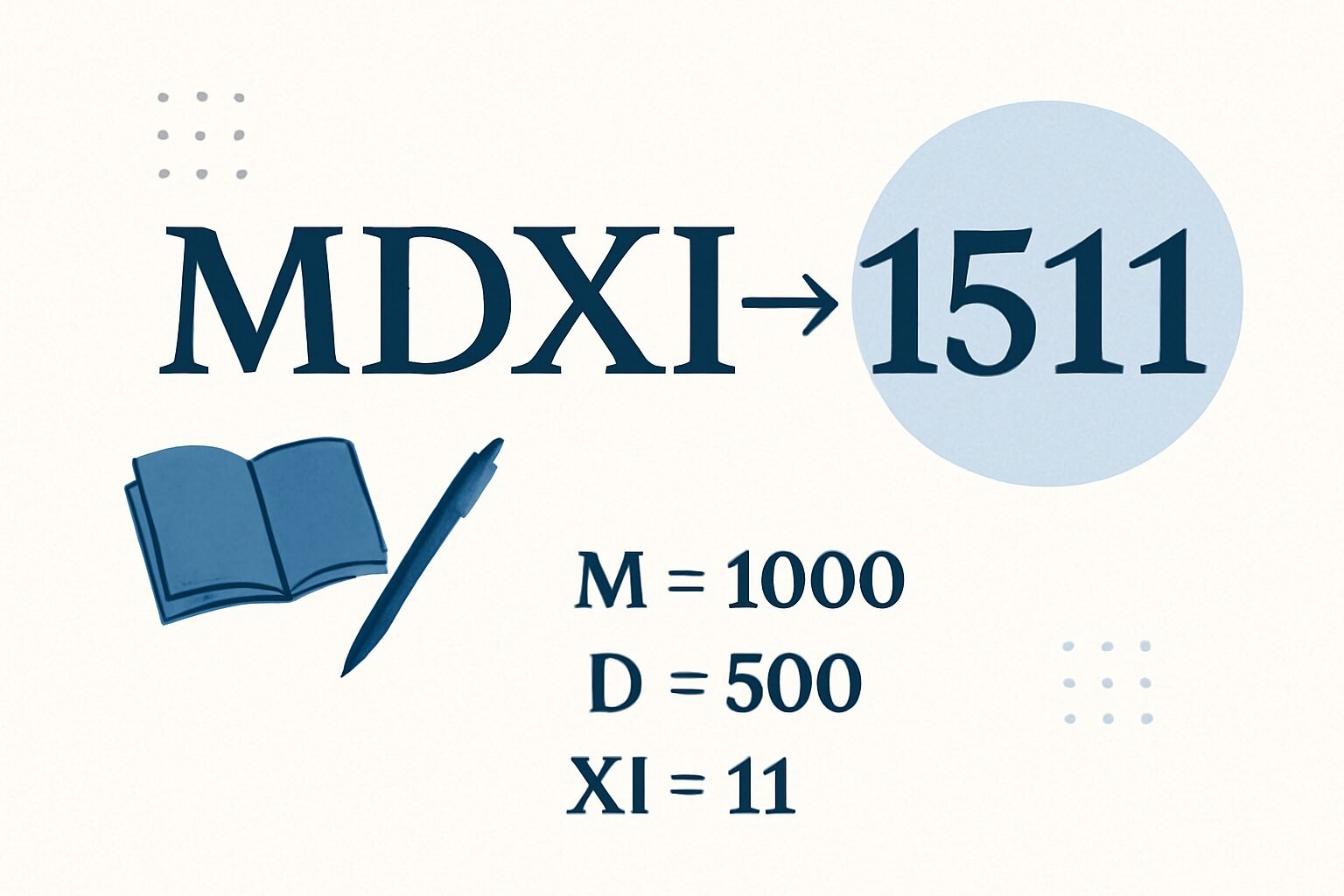
Roman numerals are made up of seven letters: I (1), V (5), X (10), L (50), C (100), D (500), and M (1000). To write a number like 1511, we combine these letters starting from the largest value and working down to the smallest.
Let's break 1511 into parts and build the Roman numeral step by step:
1000 fits into what's left of the number one time.
That means we add M to our Roman numeral because one × one thousand equals 1000.
500 fits into what's left of the number one time.
That means we add D to our Roman numeral because one × five hundred equals 500.
10 fits into what's left of the number one time.
That means we add X to our Roman numeral because one × ten equals 10.
1 fits into what's left of the number one time.
That means we add I to our Roman numeral because one × one equals 1.
Final Answer
After combining all the parts, the Roman numeral for 1511 is:
MDXI
Tip: If a smaller numeral appears before a larger one (like IV), it means you subtract. If a smaller one comes after a larger one (like VI), it means you add. You'll see both styles when needed.
How to Convert the Roman Numeral MDXI into a Normal Number
To convert a Roman numeral to a normal number, we read it from left to right and add up the values of each symbol. However, if a smaller symbol appears before a larger one, we subtract the smaller value instead of adding it.
Let's break down MDXI step by step:
Step 1: We see M, which means we add one thousand (add 1000).
Step 2: We see D, which means we add five hundred (add 500).
Step 3: We see X, which means we add ten (add 10).
Step 4: We see I, which means we add one (add 1).
Total calculation: M (1000) + D (500) + X (10) + I (1) = 1511
Final Answer
The normal number for the Roman numeral MDXI is:
1511
Tip: Remember the key rule. If a smaller numeral appears before a larger one (like IV), subtract the smaller value. If a smaller one comes after a larger one (like VI), add the values together.
What happened in the year 1511?
In the year 1511, the Portuguese conquered Malacca, establishing a key foothold in Southeast Asia.
In the year 1511, the first African slaves were brought to the New World, arriving in Santo Domingo.
In the year 1511, the University of Aberdeen was founded in Scotland by Bishop William Elphinstone.
In the year 1511, the Spanish Crown issued the Laws of Burgos, regulating the treatment of indigenous peoples in the Americas.
In the year 1511, the Italian Renaissance artist Raphael began work on his famous fresco "The School of Athens."