How to Convert 1833 into Roman Numerals
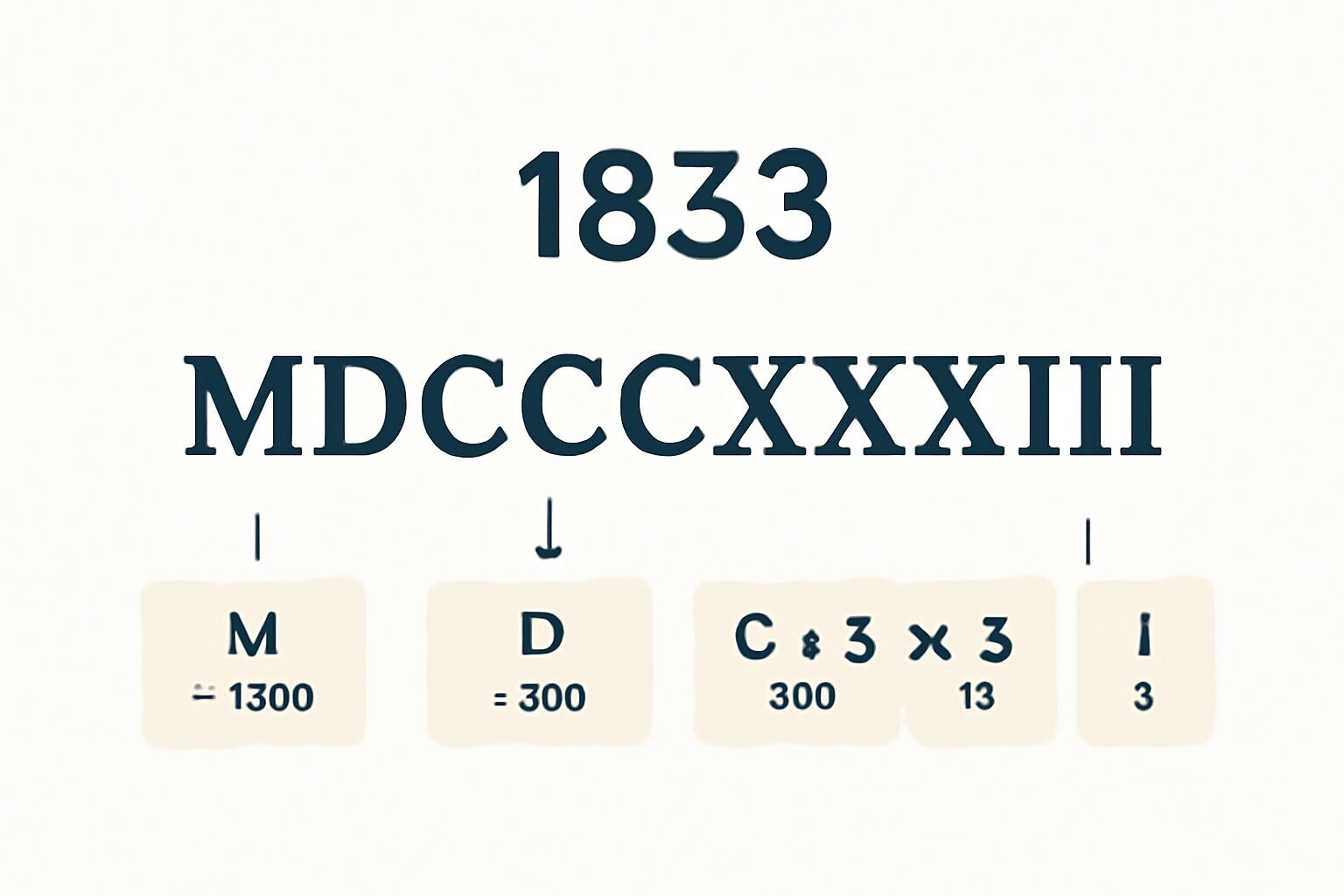
Roman numerals are made up of seven letters: I (1), V (5), X (10), L (50), C (100), D (500), and M (1000). To write a number like 1833, we combine these letters starting from the largest value and working down to the smallest.
Let's break 1833 into parts and build the Roman numeral step by step:
1000 fits into what's left of the number one time.
That means we add M to our Roman numeral because one × one thousand equals 1000.
500 fits into what's left of the number one time.
That means we add D to our Roman numeral because one × five hundred equals 500.
100 fits into what's left of the number three times.
That means we add CCC to our Roman numeral because three × one hundred equals 300.
10 fits into what's left of the number three times.
That means we add XXX to our Roman numeral because three × ten equals 30.
1 fits into what's left of the number three times.
That means we add III to our Roman numeral because three × one equals 3.
Final Answer
After combining all the parts, the Roman numeral for 1833 is:
MDCCCXXXIII
Tip: If a smaller numeral appears before a larger one (like IV), it means you subtract. If a smaller one comes after a larger one (like VI), it means you add. You'll see both styles when needed.
How to Convert the Roman Numeral MDCCCXXXIII into a Normal Number
To convert a Roman numeral to a normal number, we read it from left to right and add up the values of each symbol. However, if a smaller symbol appears before a larger one, we subtract the smaller value instead of adding it.
Let's break down MDCCCXXXIII step by step:
Step 1: We see M, which means we add one thousand (add 1000).
Step 2: We see D, which means we add five hundred (add 500).
Step 3: We see C, which means we add one hundred (add 100).
Step 4: We see C, which means we add one hundred (add 100).
Step 5: We see C, which means we add one hundred (add 100).
Step 6: We see X, which means we add ten (add 10).
Step 7: We see X, which means we add ten (add 10).
Step 8: We see X, which means we add ten (add 10).
Step 9: We see I, which means we add one (add 1).
Step 10: We see I, which means we add one (add 1).
Step 11: We see I, which means we add one (add 1).
Total calculation: M (1000) + D (500) + C (100) + C (100) + C (100) + X (10) + X (10) + X (10) + I (1) + I (1) + I (1) = 1833
Final Answer
The normal number for the Roman numeral MDCCCXXXIII is:
1833
Tip: Remember the key rule. If a smaller numeral appears before a larger one (like IV), subtract the smaller value. If a smaller one comes after a larger one (like VI), add the values together.
Number Analysis of 1833
What happened in the year 1833?
In the year 1833, slavery was abolished throughout the British Empire.
In the year 1833, Oberlin College was founded in Ohio, becoming the first U.S. institution to regularly admit female and black students.
In the year 1833, the Whig Party was officially established in the United States.
In the year 1833, Charles Babbage began designing the Analytical Engine, an early mechanical computer.
In the year 1833, the first U.S. penny newspaper, the New York Sun, began publication.