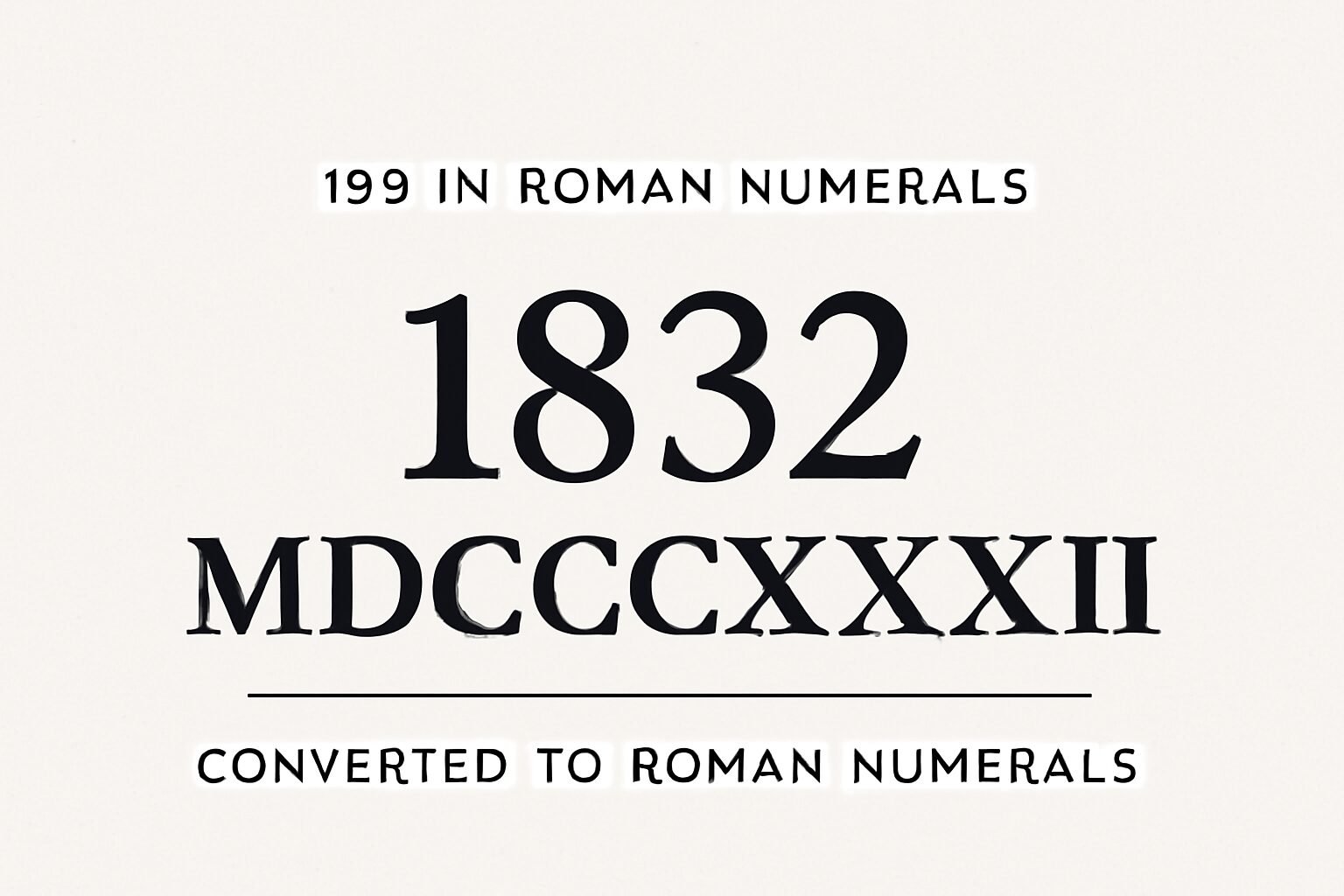
How to Convert 1832 into Roman Numerals
Roman numerals are made up of seven letters: I (1), V (5), X (10), L (50), C (100), D (500), and M (1000). To write a number like 1832, we combine these letters starting from the largest value and working down to the smallest.
Let's break 1832 into parts and build the Roman numeral step by step:
1000 fits into what's left of the number one time.
That means we add M to our Roman numeral because one × one thousand equals 1000.
500 fits into what's left of the number one time.
That means we add D to our Roman numeral because one × five hundred equals 500.
100 fits into what's left of the number three times.
That means we add CCC to our Roman numeral because three × one hundred equals 300.
10 fits into what's left of the number three times.
That means we add XXX to our Roman numeral because three × ten equals 30.
1 fits into what's left of the number two times.
That means we add II to our Roman numeral because two × one equals 2.
Final Answer
After combining all the parts, the Roman numeral for 1832 is:
MDCCCXXXII
Tip: If a smaller numeral appears before a larger one (like IV), it means you subtract. If a smaller one comes after a larger one (like VI), it means you add. You'll see both styles when needed.
How to Convert the Roman Numeral MDCCCXXXII into a Normal Number
To convert a Roman numeral to a normal number, we read it from left to right and add up the values of each symbol. However, if a smaller symbol appears before a larger one, we subtract the smaller value instead of adding it.
Let's break down MDCCCXXXII step by step:
Step 1: We see M, which means we add one thousand (add 1000).
Step 2: We see D, which means we add five hundred (add 500).
Step 3: We see C, which means we add one hundred (add 100).
Step 4: We see C, which means we add one hundred (add 100).
Step 5: We see C, which means we add one hundred (add 100).
Step 6: We see X, which means we add ten (add 10).
Step 7: We see X, which means we add ten (add 10).
Step 8: We see X, which means we add ten (add 10).
Step 9: We see I, which means we add one (add 1).
Step 10: We see I, which means we add one (add 1).
Total calculation: M (1000) + D (500) + C (100) + C (100) + C (100) + X (10) + X (10) + X (10) + I (1) + I (1) = 1832
Final Answer
The normal number for the Roman numeral MDCCCXXXII is:
1832
Tip: Remember the key rule. If a smaller numeral appears before a larger one (like IV), subtract the smaller value. If a smaller one comes after a larger one (like VI), add the values together.
Number Analysis of 1832
What happened in the year 1832?
In the year 1832, the British Parliament passed the Great Reform Act, expanding voting rights and reshaping the electoral system.
In the year 1832, the Black Hawk War ended in the United States, concluding the conflict between American forces and Native American tribes.
In the year 1832, the first horse-drawn streetcar began operation in New York City, improving urban public transportation.
In the year 1832, the British scientist Michael Faraday discovered the laws of electrolysis, advancing the field of electrochemistry.
In the year 1832, the city of Chicago was officially incorporated, marking its early growth and development.
In the year 1832, the first clipper ship, the Ann McKim, was launched, revolutionizing maritime trade with its speed.
In the year 1832, Johann Wolfgang von Goethe's masterpiece "Faust" was published posthumously, enriching world literature.
In the year 1832, the Treaty of Constantinople recognized Greece as an independent kingdom, ending years of struggle.
In the year 1832, the first cholera pandemic reached Europe, causing widespread health crises and social disruption.
In the year 1832, the British author Lewis Carroll, famous for "Alice's Adventures in Wonderland," was born.