How to Convert 1904 into Roman Numerals
Roman numerals are made up of seven letters: I (1), V (5), X (10), L (50), C (100), D (500), and M (1000). To write a number like 1904, we combine these letters starting from the largest value and working down to the smallest.
Let's break 1904 into parts and build the Roman numeral step by step:
1000 fits into what's left of the number one time.
That means we add M to our Roman numeral because one × one thousand equals 1000.
900 fits into what's left of the number one time.
That means we add CM to our Roman numeral because one × nine hundred equals 900.
4 fits into what's left of the number one time.
That means we add IV to our Roman numeral because one × four equals 4.
Final Answer
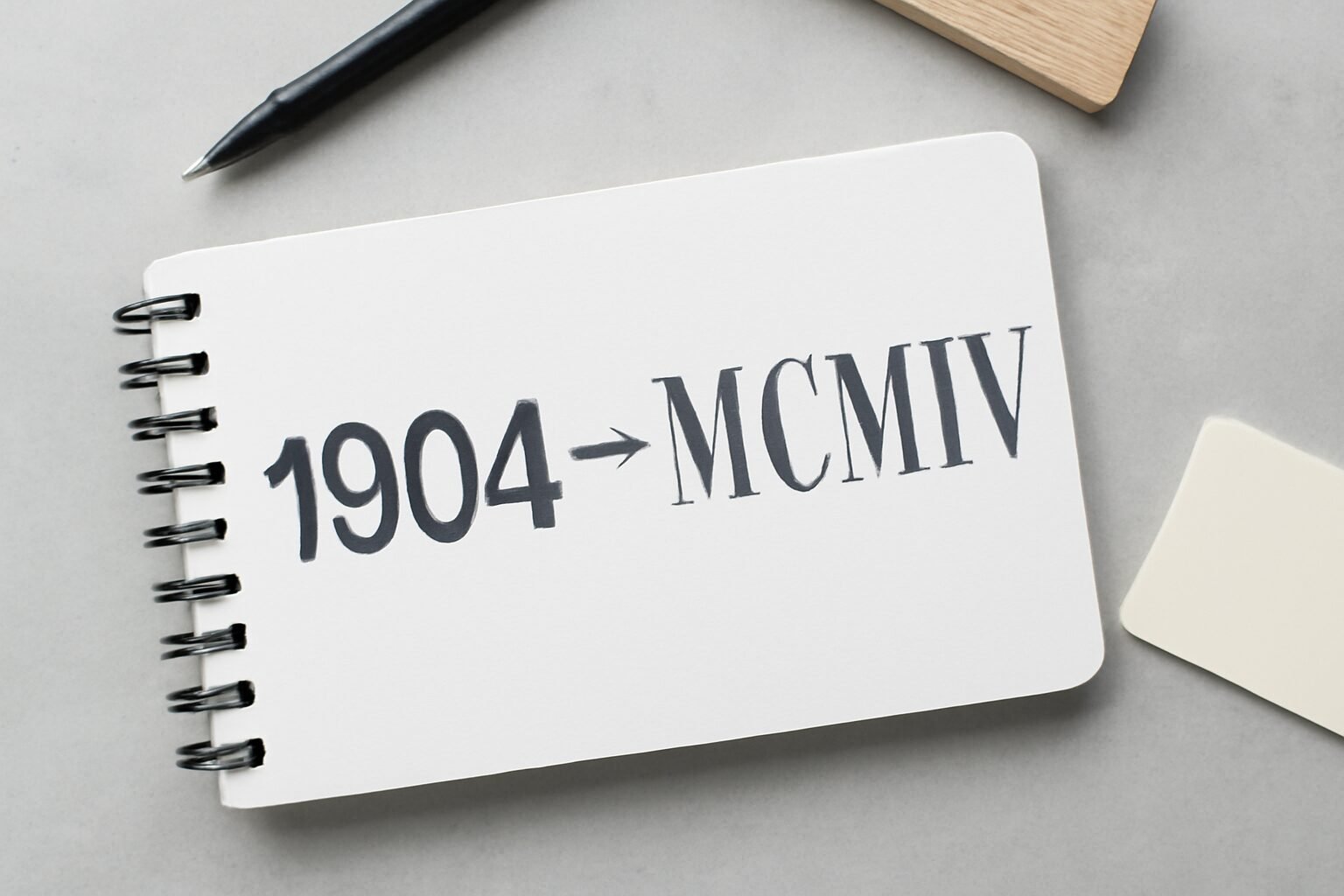
After combining all the parts, the Roman numeral for 1904 is:
MCMIV
Tip: If a smaller numeral appears before a larger one (like IV), it means you subtract. If a smaller one comes after a larger one (like VI), it means you add. You'll see both styles when needed.
How to Convert the Roman Numeral MCMIV into a Normal Number
To convert a Roman numeral to a normal number, we read it from left to right and add up the values of each symbol. However, if a smaller symbol appears before a larger one, we subtract the smaller value instead of adding it.
Let's break down MCMIV step by step:
Step 1: We see M, which means we add one thousand (add 1000).
Step 2: We see CM, which means we subtract nine hundred (subtract 900).
This is a subtraction case because C is smaller than M.
Step 3: We see IV, which means we subtract four (subtract 4).
This is a subtraction case because I is smaller than V.
Total calculation: M (1000) + CM (900) + IV (4) = 1904
Final Answer
The normal number for the Roman numeral MCMIV is:
1904
Tip: Remember the key rule. If a smaller numeral appears before a larger one (like IV), subtract the smaller value. If a smaller one comes after a larger one (like VI), add the values together.
Number Analysis of 1904
What happened in the year 1904?
In the year 1904, the New York City subway system opened, becoming one of the world's largest rapid transit systems.
In the year 1904, the Russo-Japanese War began, marking a significant conflict between the two empires over territorial ambitions in East Asia.
In the year 1904, the first Olympic Games held in the United States took place in St. Louis, Missouri.
In the year 1904, the ice cream cone was introduced at the St. Louis World's Fair, delighting attendees with its edible container.
In the year 1904, Peter Pan premiered in London, enchanting audiences with J.M. Barrie's timeless story of the boy who wouldn't grow up.
In the year 1904, the first successful vacuum tube diode was invented by John Ambrose Fleming, paving the way for modern electronics.
In the year 1904, the Entente Cordiale was signed between Britain and France, easing colonial tensions and strengthening diplomatic ties.
In the year 1904, the first Tour de France was held, though it was actually the second edition after the 1903 inaugural race.
In the year 1904, the first daily comic strip, "Little Nemo in Slumberland" by Winsor McCay, began publication, showcasing innovative artistry.
In the year 1904, the first section of the Panama Canal was completed by the United States after taking over the project from France.