How to Convert 3728 into Roman Numerals
Roman numerals are made up of seven letters: I (1), V (5), X (10), L (50), C (100), D (500), and M (1000). To write a number like 3728, we combine these letters starting from the largest value and working down to the smallest.
Let's break 3728 into parts and build the Roman numeral step by step:
1000 fits into what's left of the number three times.
That means we add MMM to our Roman numeral because three × one thousand equals 3000.
500 fits into what's left of the number one time.
That means we add D to our Roman numeral because one × five hundred equals 500.
100 fits into what's left of the number two times.
That means we add CC to our Roman numeral because two × one hundred equals 200.
10 fits into what's left of the number two times.
That means we add XX to our Roman numeral because two × ten equals 20.
5 fits into what's left of the number one time.
That means we add V to our Roman numeral because one × five equals 5.
1 fits into what's left of the number three times.
That means we add III to our Roman numeral because three × one equals 3.
Final Answer
After combining all the parts, the Roman numeral for 3728 is:
MMMDCCXXVIII
Tip: If a smaller numeral appears before a larger one (like IV), it means you subtract. If a smaller one comes after a larger one (like VI), it means you add. You'll see both styles when needed.
How to Convert the Roman Numeral MMMDCCXXVIII into a Normal Number
To convert a Roman numeral to a normal number, we read it from left to right and add up the values of each symbol. However, if a smaller symbol appears before a larger one, we subtract the smaller value instead of adding it.
Let's break down MMMDCCXXVIII step by step:
Step 1: We see M, which means we add one thousand (add 1000).
Step 2: We see M, which means we add one thousand (add 1000).
Step 3: We see M, which means we add one thousand (add 1000).
Step 4: We see D, which means we add five hundred (add 500).
Step 5: We see C, which means we add one hundred (add 100).
Step 6: We see C, which means we add one hundred (add 100).
Step 7: We see X, which means we add ten (add 10).
Step 8: We see X, which means we add ten (add 10).
Step 9: We see V, which means we add five (add 5).
Step 10: We see I, which means we add one (add 1).
Step 11: We see I, which means we add one (add 1).
Step 12: We see I, which means we add one (add 1).
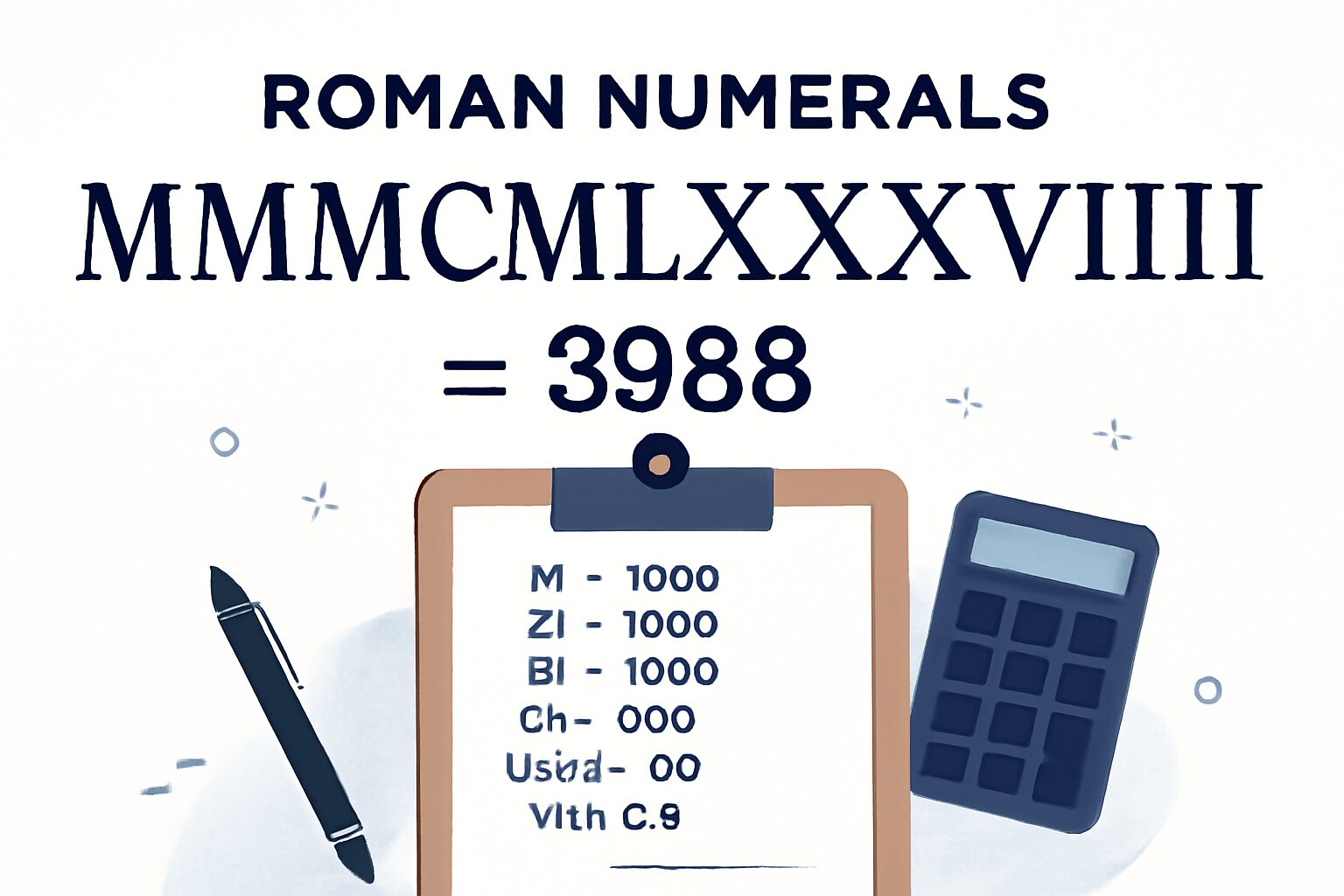
Total calculation: M (1000) + M (1000) + M (1000) + D (500) + C (100) + C (100) + X (10) + X (10) + V (5) + I (1) + I (1) + I (1) = 3728
Final Answer
The normal number for the Roman numeral MMMDCCXXVIII is:
3728
Tip: Remember the key rule. If a smaller numeral appears before a larger one (like IV), subtract the smaller value. If a smaller one comes after a larger one (like VI), add the values together.
Number Analysis of 3728
What happened in the year 3728?
In the year 3728, the first human settlement on Kepler-186f was officially established, marking a new era of interstellar colonization.
In the year 3728, the Global Ocean Cleanup Initiative successfully removed the last traces of historical plastic pollution, restoring marine ecosystems to pre-industrial health.
In the year 3728, the annual Interplanetary Arts Festival on Mars debuted holographic sculptures that responded to viewers' brainwaves, creating personalized immersive experiences.
In the year 3728, scientists announced the discovery of a new form of sustainable energy derived from quantum vacuum fluctuations, revolutionizing power generation across the solar system.
In the year 3728, the United Earth Council passed the Universal Language Accord, making a simplified form of interspecies communication standard for all diplomatic and trade interactions.