How to Convert 1488 into Roman Numerals
Roman numerals are made up of seven letters: I (1), V (5), X (10), L (50), C (100), D (500), and M (1000). To write a number like 1488, we combine these letters starting from the largest value and working down to the smallest.
Let's break 1488 into parts and build the Roman numeral step by step:
1000 fits into what's left of the number one time.
That means we add M to our Roman numeral because one × one thousand equals 1000.
400 fits into what's left of the number one time.
That means we add CD to our Roman numeral because one × four hundred equals 400.
50 fits into what's left of the number one time.
That means we add L to our Roman numeral because one × fifty equals 50.
10 fits into what's left of the number three times.
That means we add XXX to our Roman numeral because three × ten equals 30.
5 fits into what's left of the number one time.
That means we add V to our Roman numeral because one × five equals 5.
1 fits into what's left of the number three times.
That means we add III to our Roman numeral because three × one equals 3.
Final Answer
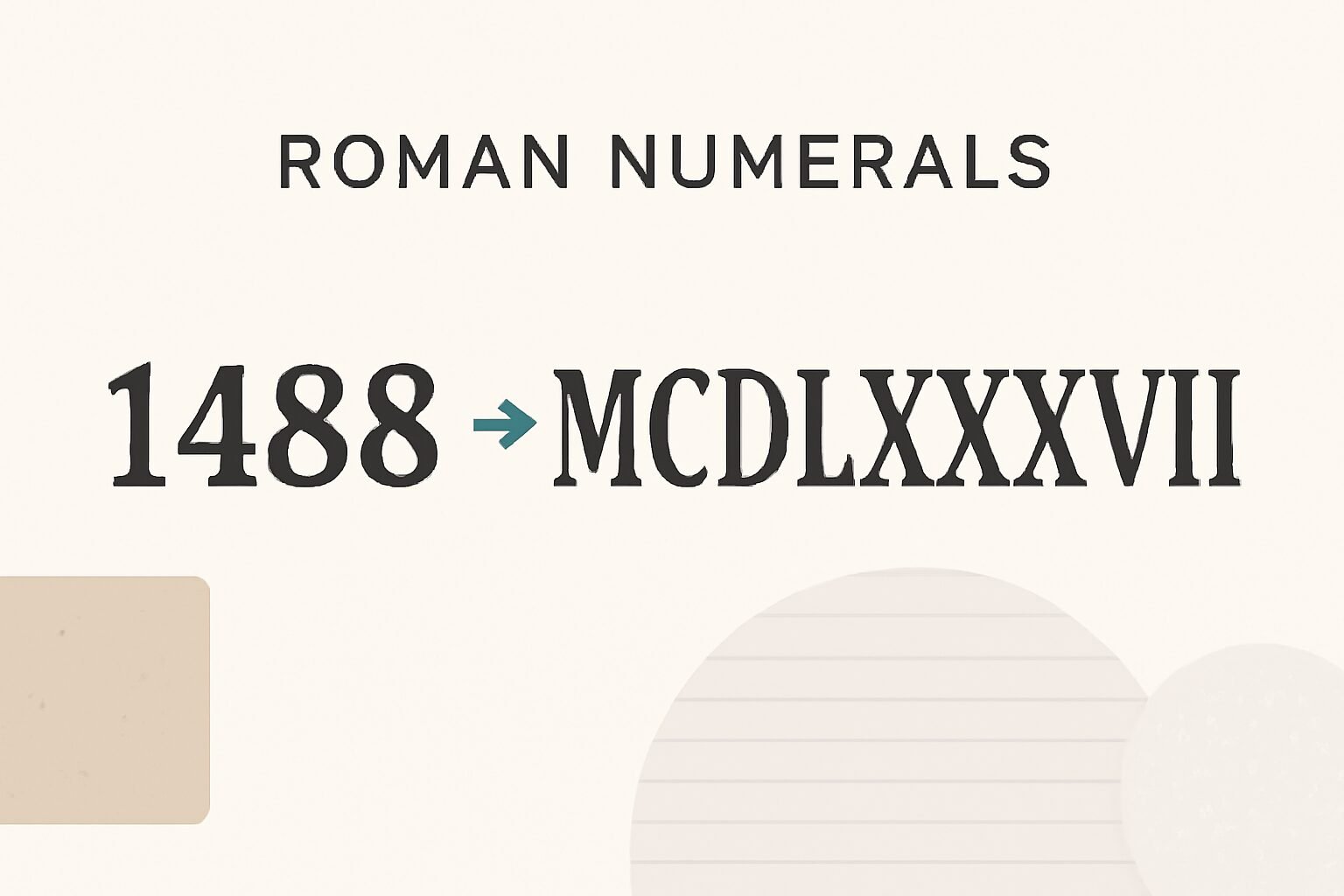
After combining all the parts, the Roman numeral for 1488 is:
MCDLXXXVIII
Tip: If a smaller numeral appears before a larger one (like IV), it means you subtract. If a smaller one comes after a larger one (like VI), it means you add. You'll see both styles when needed.
How to Convert the Roman Numeral MCDLXXXVIII into a Normal Number
To convert a Roman numeral to a normal number, we read it from left to right and add up the values of each symbol. However, if a smaller symbol appears before a larger one, we subtract the smaller value instead of adding it.
Let's break down MCDLXXXVIII step by step:
Step 1: We see M, which means we add one thousand (add 1000).
Step 2: We see CD, which means we subtract four hundred (subtract 400).
This is a subtraction case because C is smaller than D.
Step 3: We see L, which means we add fifty (add 50).
Step 4: We see X, which means we add ten (add 10).
Step 5: We see X, which means we add ten (add 10).
Step 6: We see X, which means we add ten (add 10).
Step 7: We see V, which means we add five (add 5).
Step 8: We see I, which means we add one (add 1).
Step 9: We see I, which means we add one (add 1).
Step 10: We see I, which means we add one (add 1).
Total calculation: M (1000) + CD (400) + L (50) + X (10) + X (10) + X (10) + V (5) + I (1) + I (1) + I (1) = 1488
Final Answer
The normal number for the Roman numeral MCDLXXXVIII is:
1488
Tip: Remember the key rule. If a smaller numeral appears before a larger one (like IV), subtract the smaller value. If a smaller one comes after a larger one (like VI), add the values together.
Number Analysis of 1488
What happened in the year 1488?
In the year 1488, Portuguese explorer Bartolomeu Dias became the first European to sail around the southern tip of Africa, naming it the Cape of Good Hope.
In the year 1488, the Sistine Chapel in Vatican City was consecrated by Pope Innocent VIII.
In the year 1488, Leonardo da Vinci began his detailed anatomical studies, sketching the human skull and other parts.
In the year 1488, King James III of Scotland was killed at the Battle of Sauchieburn, leading to the ascension of his son James IV.
In the year 1488, the first edition of Homer's works was printed in Florence, contributing to the revival of classical learning.