How to Convert 1520 into Roman Numerals
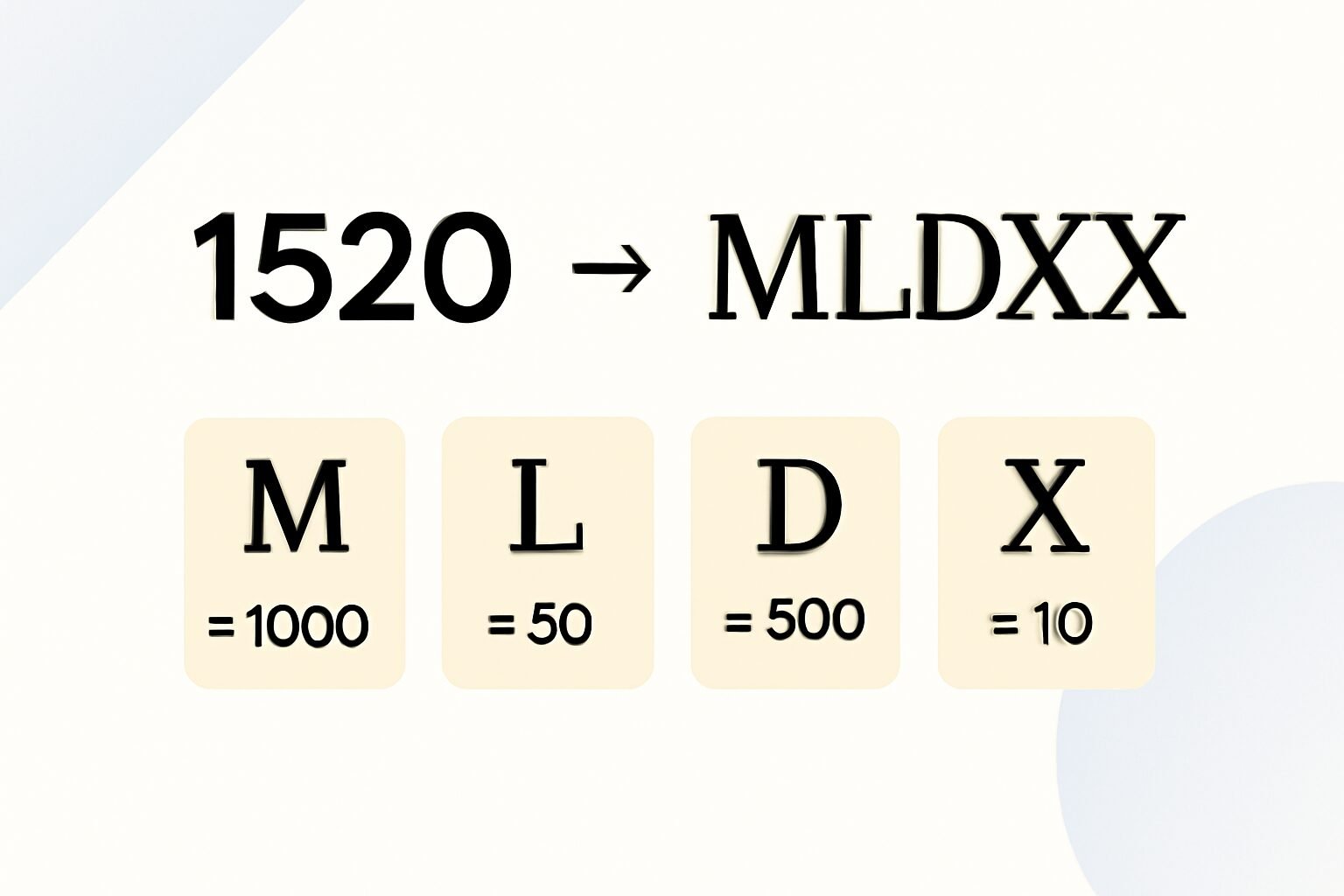
Roman numerals are made up of seven letters: I (1), V (5), X (10), L (50), C (100), D (500), and M (1000). To write a number like 1520, we combine these letters starting from the largest value and working down to the smallest.
Let's break 1520 into parts and build the Roman numeral step by step:
1000 fits into what's left of the number one time.
That means we add M to our Roman numeral because one × one thousand equals 1000.
500 fits into what's left of the number one time.
That means we add D to our Roman numeral because one × five hundred equals 500.
10 fits into what's left of the number two times.
That means we add XX to our Roman numeral because two × ten equals 20.
Final Answer
After combining all the parts, the Roman numeral for 1520 is:
MDXX
Tip: If a smaller numeral appears before a larger one (like IV), it means you subtract. If a smaller one comes after a larger one (like VI), it means you add. You'll see both styles when needed.
How to Convert the Roman Numeral MDXX into a Normal Number
To convert a Roman numeral to a normal number, we read it from left to right and add up the values of each symbol. However, if a smaller symbol appears before a larger one, we subtract the smaller value instead of adding it.
Let's break down MDXX step by step:
Step 1: We see M, which means we add one thousand (add 1000).
Step 2: We see D, which means we add five hundred (add 500).
Step 3: We see X, which means we add ten (add 10).
Step 4: We see X, which means we add ten (add 10).
Total calculation: M (1000) + D (500) + X (10) + X (10) = 1520
Final Answer
The normal number for the Roman numeral MDXX is:
1520
Tip: Remember the key rule. If a smaller numeral appears before a larger one (like IV), subtract the smaller value. If a smaller one comes after a larger one (like VI), add the values together.
Number Analysis of 1520
What happened in the year 1520?
In the year 1520, King Henry VIII of England and King Francis I of France met at the Field of the Cloth of Gold in a grand display of wealth and diplomacy.
In the year 1520, the Aztec capital Tenochtitlan was besieged by Spanish conquistadors led by Hernán Cortés.
In the year 1520, Martin Luther was excommunicated by Pope Leo X for his criticisms of the Catholic Church.
In the year 1520, Ferdinand Magellan's expedition discovered the strait at the southern tip of South America, later named the Strait of Magellan.
In the year 1520, Suleiman the Magnificent became the Sultan of the Ottoman Empire, beginning a long and influential reign.
In the year 1520, the first major smallpox epidemic in the Americas devastated indigenous populations, brought by European explorers.